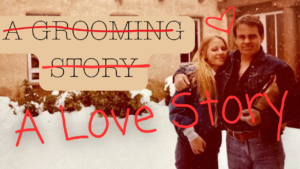
The following is the script of the above YouTube video.
Elizabeth Gilbert, who you may know as the author of the worldwide phenomenon Eat, Pray, Love, published a book a few months ago called All the Way to the River: Loss, Loss, and Liberation.
Despite what you might have heard about Elizabeth Gilbert, I want to clarify that she isn’t some vapid, chick-lit writer who creates Hallmark plots.
In the 90s, when she lived in New York, she was shortlisted for the National Book Award twice before even writing Eat, Pray, Love. Her early short stories “The Finest Wife” and “Elk Talk” are still frequently taught and discussed in MFA programs. You might be familiar with the movie from 2000, Coyote Ugly, which was also an adaptation of an essay that Gilbert wrote for GQ about herself and the girls who worked at a gritty New York City dive bar when she says she measured a successful night by how many marriage proposals she got.
When I read a Jia Tolentino review of Gilbert’s latest book, I kept reading quotes singing Gilbert’s praises from writers I idolize, like Jennifer Egan and Cheryl Strayed. I realized, reading these reviews, that Elizabeth Gilbert used to be my favorite authors’ favorite author.
For the 90s and early 2000s, Elizabeth Gilbert was a promising, scrappy, and plucky indie author whom everyone from the stuffy academics to the underground New York City artists pointed at and said, “That girl is gonna do something big.”
And then she did.
Eat, Pray, Love
In 2006, she wrote Eat, Pray, Love. A quick recap: Eat, Pray, Love is a memoir, and it opens with Gilbert sobbing crying on her bathroom floor because she feels stuck in her first marriage and she wants out. So she gets what would be her first divorce; she has a devastating situationship, and in the wake of that breakup, she has an epiphany. She needs to discover who she is without a man. She sells everything, she swears off sex, and she goes on a three-part journey: Italy, to eat, India, to pray, and Indonesia, where she falls in love with a Brazilian man who would become her second husband. This book went on to become the single most successful memoir of the decade. It was on the top of the bestseller list for years; it was turned into a blockbuster film starring the beloved actress Julia Roberts and Javier Bardem. And suddenly Gilbert had millions of fans and more money than she knew how to spend.
After Eat, Pray, Love, Gilbert continued to put out high-quality writing. She became a respected speaker with multiple TED Talks. She wrote a book called Big Magic, which is like an advice book for creatives. She put out a lot of fiction. And along with being a famous writer, she also became a sort of spiritual guide and developed a following of people who saw her as an almost saint-like figure.
All the Way to the River Comes Out
Then, this year, in September, Gilbert put out another memoir called All the Way to the River: Love, Loss and Liberation. Fans were expecting a breezy, spiritual, colorful story written in Elizabeth Gilbert’s signature style. Instead, when they started marketing this book, we readers were told a story that was as surprising as it was disturbing. According to these marketing materials and early snippets, it sounded like Gilbert fell in love with her hairdresser, a woman named Rayya Elias who was a former addict; then, when Rayya got a terminal cancer diagnosis, Gilbert left her husband to party with Rayya as her lover for her final days. But then, when Rayya’s addiction got bad again, Gilbert decided that she would murder Rayya, literally. Rayya caught on to Gilbert’s plan, so Gilbert didn’t go through with it. Then Gilbert decided the whole experience was too degrading to her soul, so she broke up with Rayya. When we get into the synopsis in a minute, you can see for yourself how accurate or inaccurate that version of events was.
Because of the way this book was marketed and the story that was told through the marketing, I thought I would dislike the book because of Gilbert’s poor decisions or even cruelty in it, but that was not the case. I still didn’t like the book. But not because of Gilbert’s bad decisions, although they did make the book tough to read sometimes; I didn’t like the book because I did not think it was well-written. And what I kept asking myself, and what I would like to explore in this review, is: what happened? How did somebody who was a widely acclaimed, good writer put out something that was, I thought, poor quality?
My first draft of this review was a roast of this book. Then, I met with my book club.
You can join my book club via my Patreon for three dollars a month at this link.
And while many people in my book club meeting also didn’t like the book, there were people who felt like they got a lot out of it. For example, there is profound value in writing honestly about the messiness of caretaking, of end-of-life care, and relapse. Also, if you are at a moment of reckoning with your relationship with sex and love, and thinking you might be addicted to love or to a certain person to your detriment, especially if you are a woman, then you might be the target audience for this book, and you might find something here that I did not. So I will still roast the book, but my roast will be punctuated by observations from people in my book club who liked the book, making it a light roast– medium rare, if you will.
Ok, let’s go through a summary of the book so that we’re all on the same page, then I’ll get into my review.
Book Summary
The book is written in short chapters about Gilbert’s relationship with Rayya, interspersed with poems and doodles. Most of the poems are written from the perspective of God talking to Elizabeth Gilbert like a baby. And I am not exaggerating: Gilbert’s version of God calls her “kiddo,” and tells her that she hasn’t done anything wrong, and if she ever did do anything wrong, it was not her fault; it was because she was an addict. Elisabeth Egan with The New York Times reviewed this book and compared reading these poems with getting stuck in the face with pins, and I have to say I agree– the poems were probably the worst part of the book for me. Gilbert also includes a lot of doodles, and I am intentionally calling them doodles, not sketches or even drawings because they look like something you would draw during Geometry class.
The book starts with one of these poems, called “An Invocation.” It reads:
“I.
I came.
I came to.
I came to believe.
I came to believe that a power greater than myself could restore me.
I came to believe that a power greater than myself could restore me to sanity.”
Then Gilbert explains that on her 54th birthday, Rayya, who had been dead for more than five years at this point, came to her to visit her and speak to her in a vision.
Gilbert explains that since Rayya passed, Gilbert has gotten sober from drugs, alcohol, sex, and love. Something that is very noticeable in Gilbert’s prose is that it’s become much more clipped than in her previous books. She’s using the Enter key a lot, and she’s also using italics and casual slang terms or even references to Internet memes pretty often. As a result, the prose feels very choppy and informal, almost as if it were a speech or a social media post.
Listen to how Gilbert describes this visit from Rayya (this is not a poem; this is in one of the prose chapters):
“Where had she gone?
Had she moved on, or had I left her behind?
I could make no sense of it.
It was as if she’d stepped out of the universe for a pack of cigarettes and had never come back.
But now–on the morning of my fifty-fourth birthday–suddenly she was here.
I mean really here.
The room was humming with big Rayya energy, and I felt chills up my entire body.”
Rayya then gives Gilbert a big speech where she tells her that she’s proud of her, to stop worrying about other people too much, and she says, “You’re on the right track. You found your God–and your God is fucking awesome. Your God is lit!”
Rayya also tells Gilbert, “Between us and about us, shit got super fucked up at the end–and that wasn’t your fault or my fault. It wasn’t even wrong how things went. It just had to be.”
One of the top comments on my YouTube video about this topic says: “My dead girlfriend told me to write this really embarrassing memoir about her. She told me this telepathically. After she died, of course.”
Rayya then leaves Gilbert with this message:
“As for the book, just write the living shit out of that thing!!! Tell the people exactly what happened! Tell them every single thing that happened! Don’t worry about protecting my dignity or yours–just go full punk rock with it. Lay it all out there. What use do I have for dignity now? You don’t need dignity either, so fuck it. It’s time for you to write a completely honest book about addiction–yours and mine. It’ll help some people–so don’t hold back.”
Rayya then adds, “You’re going all the fucking way this time–all the way to enlightenment.” I again want to emphasize that Rayya didn’t write or say any of this during her lifetime. This is all Gilbert telling us what Rayya communicated to her posthumously in a vision. We had a long conversation in my book club about whether or not this book was exploitative to Rayya, and in that debate, this first chapter, this spirited blessing of the book through Rayya’s mouth, came up a lot, and I’ll go into more detail when I’m reviewing the book.
In the next chapter, Gilbert gets into describing Rayya in depth. Rayya was born in Syria; she was a child in Aleppo, then raised in Detroit, then as a young adult moved to the Lower East Side in New York City. Gilbert says Rayya never felt fully at home anywhere, and her parents were hard-working and had been affluent in Syria, and they simply could not make sense of Rayya. She was wild and disobedient from a young age and was already sneaking out and selling acid by the time she was 13. Rayya had grown up in a religious, Orthodox community, so she didn’t come out until she was in her early 20s, but she always presented as quite androgynous. Gilbert writes about Rayya’s “dark eyes and dramatic cheekbones” and says, “her face changed from male to female, from wise to playful, from timeless to childish as the light shifted.” And you’ll notice that keeps happening: There are these moments when Gilbert’s old style of prose peaks through the choppy, conversational style, and you get this glimmer of nostalgia as you remember that she was a fantastic writer. These moments seem to come through more often when she is describing Rayya with love.
Gilbert characterizes Rayya as a talented creative: a musician, writer, filmmaker, and hairdresser. But she also struggled with insecurity and shame and creative paralysis, and she passed away without ever having become as successful as she wanted to be.
She says Rayya got in a lot of trouble, but could talk herself out of anything. She says that Rayya has been in and out of jail, in and out of rehab, and was homeless for long spans of time. Rayya did get clean, but then after about a decade of going to Alcoholics Anonymous and Narcotics Anonymous, she said she didn’t want to label herself as an addict anymore and “graduated herself” from recovery. Gilbert also describes a very, very strong community of chosen family that Rayya surrounded herself with. She was still close with all of her exes. Gilbert says Rayya had everyone’s keys and everyone’s passwords and once dropped everything and flew halfway across the country to physically remove a friend from an abusive household. She describes Rayya as a paradox. On one hand, she’s “a needy alpha” and “a fiery Aries,” but on the other hand, Gilbert says that she witnessed Rayya’s secret soft side. Rayya was, for example, afraid of bugs and thunder; she had skin like silk, she curled up like a baby with Gilbert. This will become a motif in the book– Gilbert insisting that she saw a weakness in Rayya that nobody else saw, and in general insisting that she knew Rayya better than anyone else.
Gilbert says everyone wanted to be with Rayya, but Elizabeth Gilbert was the one whom Rayya loved the most. Gilbert describes how she left her marriage to be with Rayya when Rayya got her terminal cancer diagnosis, and she says,
“Rayya: whose return to active drug addiction made the last few months of her life a living hell for everyone involved. Whose relapse drove me so far into insanity that I once seriously contemplated murdering her, because I believed she was killing me. Rayya: who broke my heart. Rayya: Who loved me the most. Whom I loved the most.”
Gilbert explains that the title of the book, All the Way to the River, is a metaphor that Rayya used to make about having your closest friend– the friend who would walk all the way across New York City to the East River with you. This is the friend who knows everything about you, who never judges you, and Gilbert says that Rayya told her that she was that friend. As Rayya is dying, this metaphor of taking her all the way to the river becomes representative of Gilbert being with Rayya up until her death; accompanying her to the other side even through all the gritty and scary parts of the walk to the East River.
Gilbert goes on to describe how she met Rayya. It was the year 2000. Gilbert was 31 and married to her first husband, and she felt like she was following a role in life: the good girl, then good wife, then someday good mother, but she was about to fall completely in love with someone outside of her marriage, namely, James Franco (not really– that’s just who played the boyfriend in the movie). She was, at this time, a “highly-paid freelance writer” who was celebrated as an up-and-coming author. She had already written “Pilgrims” and “The Muse of the Coyote Ugly Saloon.” The Coyote Ugly movie would be released that year– Gilbert actually met her first husband while working at the Coyote Ugly Saloon in real life. So things were going very well, but she seems to perceive herself at this time as sort of square and boring. A friend recommended Rayya as a hairdresser, but said that Rayya will only cut your hair if she likes you. Rayya figured out how to deal with Gilbert’s hair (Gilbert describes her own hair as “duck fluff” four times in this book, as pointed out in the New York Times review). Gilbert describes Rayya as “funny and interesting and exotic,” which didn’t sit right with me, and she says that she liked her very much but did not fall in love with her that first day. Rayya also told Gilbert that day that she was addicted to coke and heroin for most of her adult life, but she got clean in 1997. Rayya described her life at that time, saying she got a small house and cut hair four days a week, then rode her motorcycle to the beach for the other three days, and when people encouraged her to work more days and expand her business, she told them to fuck off. Gilbert saw this as such a contrast to her own life at that moment, when she felt like she was living for everyone else all the time. But Rayya was impressed with Gilbert because Gilbert made a living as a creative, and Rayya had a tormented relationship with her own creativity. For example, she was having trouble performing music she had written now that she was sober. Sober, she had paralyzing stage fright, and she was only ever able to perform previously because of her addictions.
In the next chapter, Gilbert talks a lot about sex and love addiction and especially about the process of being a sex and love addict as a woman. Gilbert writes,
“My desperation to be loved is certainly outsize, and it has caused me to act out in ways that are undeniably insane. Yet I suspect that parts of my story may feel familiar to many of my readers– especially my female readers, who, like me, may have been socialized since birth to believe that they did not possess much inherent value, but were estimable only insofar as they were capable of making themselves attractive enough to be chosen.”
I thought this chapter was well-written; she can write about feminism in a way that is accessible and relatable. It might seem like she’s doing a lot of trying to convince us that love and sex addiction is real, which you could argue is unnecessary or stemming from personal insecurity, but I actually found it quite necessary here, because for the rest of the book she is going to pitch the idea that love addiction is just as powerful and deadly as addictions to substances like heroin and fentanyl, and that’s a tough sell for a lot of readers (including me).
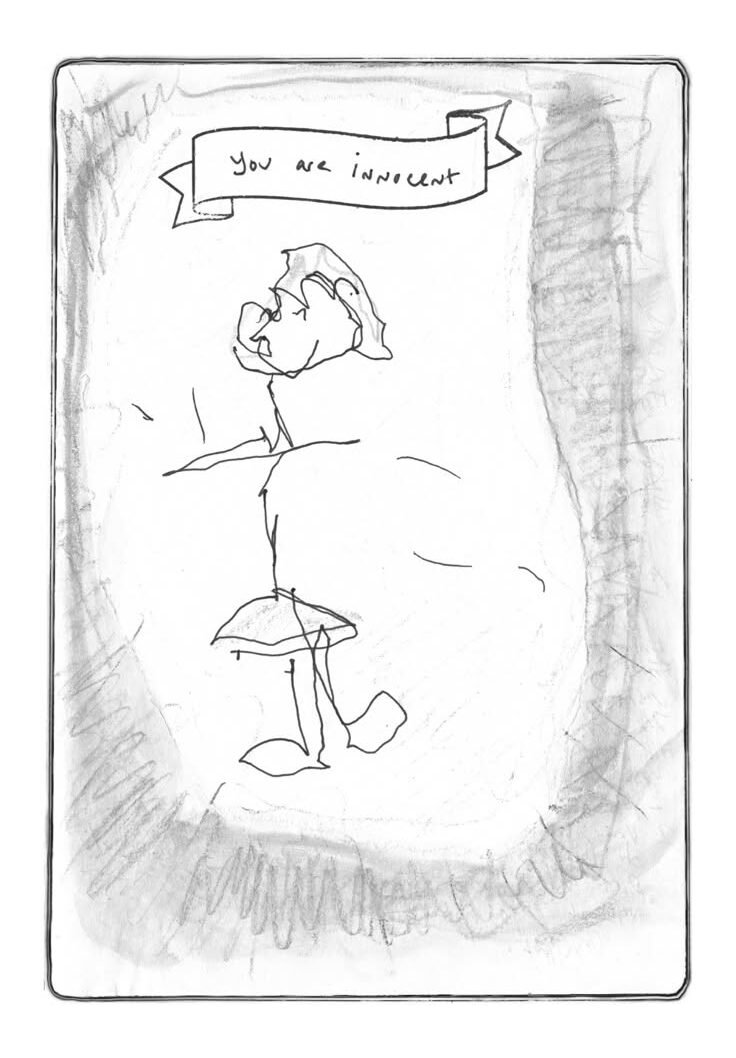
Then she has a doodle of a girl, and it says, “You are innocent.”
She then introduces the idea of “Earth school,” which is the idea that when we were flesh-less souls in the cosmos, we chose our lives so that our souls could learn difficult lessons. All of this is interspersed with poetry and doodles of flowers and such.
So she goes on to share that she and her first husband split up so she could be with James Franco; then they had a terrible breakup that left her completely floored, so she decided to sell everything and travel the world at the behest of “the voice of God,” which she hears in her mind.
Gilbert writes,
“After my divorce and my breakup, I quit my job, sold everything, and followed the God voice around the world…At the end of my travels, I met a charismatic Brazilian man who poured love, attention, validation, and approval upon me with lavish abundance. I gave myself over to him, without restraint. He gave himself over to me, too. We moved back to America and we got married.
I wrote a book about my travels.
That book became Eat Pray Love.
Suddenly I had a shit ton of money.”
She says she felt guilty about having that money, and also wanted to buy love with it. So she started giving it away in enormous chunks, buying her friends houses and paying for their weddings, and sending their kids to nice schools, and donating to causes and politicians, and paying off her friends’ debt. But she says that this spending did not end well. People ended up resenting her, arguing with her. She lost many friendships and even got in legal trouble because of this spending. Gilbert says that about half of the people whom she gave money to around that time would now “cross the street if they saw [her] coming.”
She says that around this time, Rayya was still cutting her hair and was mostly doing well. She was in a domestic partnership with a woman named Gigi, attending her twelve-step programs, trying to be stable, and she had gotten into real estate. But then, Rayya had knee surgery that didn’t heal quite right, so she started experiencing chronic pain. She and Gigi realized that they wanted different things and split up. Then 2008 came, and the real estate market, which Rayya was using to make money, completely crashed. Rayya had hepatitis C from her years of drug use, and it started flaring up and causing issues. Rayya was forced to sell the apartments she had and move into a studio in Chelsea “with no light.”
A few years prior, Gilbert had bought a church sight-unseen from an internet cafe in Laos because she saw a photo and believed that it must be her “forever home.” She wrote of this church,
“My church was–and still is– a place of quiet magic. The previous owners had done all the hard work of repurposing it into a house, so all I needed to do was move some art and furniture into the place and then sit in the great chamber at the center of the building, gazing in awe at the original soaring windows of wavy glass that perpetually drench the place with dancing light. When I got quiet enough, I could almost hear the prayers and hymns contained within these walls–the voices of the faithful and the yearning who had worshiped here for over two hundred years.”
And I made a note here that this is the type of writing that she really excels at– she takes these quiet moments of world-building that can often be quite boring and that a lot of writers really struggle with, and she makes them engaging and lively. I read Eat, Pray, Love when I was 17, so 13 years ago, and I had never left the United States, and I still remember reading the way Gilbert described eating a pizza in Italy, and the way she painted an image of the dough that was so soft it was like it was melted. And I wish that in this book, she leaned more heavily into these moments of physical description so strong it gives you synesthesia. Because so many writers struggle to make their world-building engaging, the fact that Gilbert is so good at it makes her stand out. So when she instead favors crazy plot points over descriptive writing, and she chops her prose up into little pieces with the Enter key and relies on flippant little slang quips, I feel that it’s really a fatal flaw for the book. It’s like she tried to surgically remove exactly what made her books good.
So, anyways, Gilbert and her husband decide that they don’t like living and working in the old church, so they moved out, but Gilbert kept it, planning to make it a spiritual retreat or a space for creative workshops. Instead of doing that, she gave the house to Rayya so that she doesn’t have to live in Chelsea. She says that Rayya stood in the middle of the church and wept; she could not stop crying, and she said, “Nobody’s ever given me anything like this.”
Gilbert then describes a bit of her own past of giving herself and her things and her privacy away too quickly, and to people she hardly knew because she wanted their love in exchange. She wanted to be a hero, and she wanted to be adored, and she put herself into dangerous and compromising scenarios to achieve that affection, often to disastrous ends.
Gilbert goes on to say that the initial agreement was that Rayya would live in the church for three months. Rayya ended up living there for free for nine years until she passed away.
Over the coming years, Gilbert had a highly successful public life. She gave TED Talks and built a large social media following. She published more books. She says that her relationship with her second husband was good at the time, but also says that she will not, out of respect for him, go into detail about anything about their marriage or its end. Although she does say, “We were always good to each other, we loved each other, and we are still kind to each other.” (Some would argue that it is unkind to suddenly abandon your husband to go on a sexually charged drug bender with your new lover, but I digress.)
But she says that secretly, she was constantly anxious, and panicked, and afraid. She says she always felt that there was something fundamentally broken or wrong with her, like she was never safe, but she didn’t want to share those thoughts because she felt that it made her sound ungrateful for her highly blessed life.
Through the beginning of this book, she has hinted at this anxious and urgent need to be loved as coming from a specific childhood trauma. But she says that she will not discuss this childhood trauma because there were people involved who are still alive, but it does sound like it led her to feel very unsafe as a child and to develop extremely unhealthy relationship habits as an adult. Around this time of financial prosperity from Eat, Pray, Love, she says she drank every day, took sleeping pills every night, and was constantly on and off anti-anxiety and antidepressant medications. She no longer did yoga or meditated or did any of the other spiritual practices that she had picked up on her trip to India and raved about in Eat, Pray, Love; she fell out of those habits not long after her trip.
Once Rayya moved into Gilbert’s church, the two women started to see each other practically every day, and Gilbert witnessed Rayya’s social abilities. She writes, “It turns out that Rayya had a talent for human interaction the likes of which I had never seen before, nor encountered since.” She says that Rayya was always herself and always candid. If everyone was trying to sound intellectual, then she would say, “Nobody knows what the fuck you guys are talking about.” Gilbert writes that Rayya was always irreverent, always blunt. She typically greeted Gilbert’s six-year-old godson by saying, “Hey, you little fucker.” (The parents of her godson apparently thought this was funny– there was no consideration of how the six-year-old himself felt about it.) If someone was arrogant and entitled, she would say to their face, “Wow, man, I never knew what a little bitch you could be.” Rayya constantly talked about how much she loved the truth, especially as a former addict who spent years lying and manipulating.
Gilbert tells a story about a friend who was going through a terribly messy divorce that involved cheating and lying and financial ruin, and so Gilbert started inviting this friend over for dinner a few nights a week. She says that out of polite respect for her friend, she pretended not to notice just how heavily this friend was drinking. But she invited Rayya over one night, who asked this friend how she was doing, and when the friend lied and said she was just fine, Rayya called her out, saying, “Then what’s with the yellow eyes? What’s with the booze breath? Why does your nose look like that? What’s really going on here, dude? Are we really not gonna talk about how much you’ve been drinking?” The friend then collapsed into Rayya’s arms and cried and finally opened up about how poorly she had been managing the divorce, and Rayya held her and listened, then helped her get into some recovery programs. I thought it was a powerful story, but then Gilbert did something that she keeps doing in this book: She ends the story with a little quip that is often a meme or saying or some cliché. In this chapter, she ends it by saying, in its own line and in italics, of course, “What sorcery is this?” And if my emotions and affection for these characters were swelling like a balloon during this story, then these silly little lines are the needle that pops them. A clear sign of poor writing is an over-reliance on clichés and, in more modern writing, an over-reliance on Internet memes or jokes. It makes you sound chronically online, and it takes away your credibility, and even if these memes or slang words are meant to sound funny or tongue-in-cheek, the Internet moves on so quickly that in just a few months, your language will likely already sound kind of corny and outdated. Gilbert relies on these common 2010s-era meme phrases a lot in this book. She loves the word “lit.” She calls her responsible friends “grown-ass adults” in order to contrast them with herself and Rayya (who were middle-aged at this time). And I wish that Gilbert would instead let the story speak for itself instead of coming in with these little after-school special lessons in the forms of millennial Reddit humor.
Gilbert says that she had gotten accustomed to “constant, low-grade terror,” but when Rayya was around, that terror went away. She tells another story of when the two women went to the funeral of the mother of a dear friend. A grandchild of the deceased was a young man who was in active meth addiction. The family had not invited him to the funeral because of his addiction issues, but he found out about it and showed up anyway, and when he showed up, he was enraged. Everyone tried to keep their distance, except Rayya, who walked right up to him, made a fist, knocked on his chest over his heart, and said, “How you doin’ in there, bud?” But he (shockingly!) didn’t respond well; Gilbert says, “he muttered an obscenity,” then shoved her away and rushed off. Gilbert says to Rayya, “Are you okay?” And Rayya tells Gilbert to lock up all their valuables in the car and bring her the key, then to tell everyone else at the funeral to do the same thing. And later, when Gilbert thanks Rayya for protecting everyone at the funeral from the scary, “dangerous young man,” Rayya’s eyes well up and she says, “Oh, honey, did you think I was protecting us? No, baby, no. I was protecting him… The odds are that kid doesn’t have much longer to live. He’s really far gone, and he doesn’t have any support system. But there’s always a chance he might get clean someday, with a miracle… And I don’t want that poor kid… to be forced to deal with the fact that he stole money from people at his grandmother’s funeral.” Such a good story and quote, then Gilbert ends it all with: “That was my Rayya,” which we could have done without.
The next chapter is called “Let Me Break It Down for You,” and Gilbert says that she did fall in love with Rayya pretty quickly after she moved her into the church. She was still married to someone else, but she says that Rayya was the first person she called in an emergency, her first invite to every social event, and her primary confidant. She asked Rayya for advice on nearly everything and followed her advice, often blindly, to the point where she says she found herself wondering how she ever survived without her. She was secretly in love with Rayya, but instead of having that difficult conversation with her husband, she started to find ways to keep Rayya close. So after the first summer of Rayya living in the church, Gilbert told her to stay for free, told her that she could call it a writing retreat, and encouraged her to write a memoir full-time while Gilbert covered her expenses. She said, “Give me the complete manuscript in nine months, and that will be your rent.” Rayya protested and said she did not know how to write a book, and Gilbert not only encouraged her to write, but also told her that she would give the manuscript to her agent when the book was done. Rayya was fresh out of a major breakup; her finances were still not solid at this point, she was almost 50, and her body was battered from years of drug addiction, living on the street, and also dealing with symptoms from her hepatitis C. She was having trouble being on her feet all day so she could cut hair, and for most of her life she already felt like she had failed as an artist. Now Gilbert is giving her the chance to write all day, for free, and also giving her access to a glamorous community of artists and celebrities, and possibly even the chance to become famous and successful herself as an author.
But Gilbert was also moving her far from Manhattan, where she had lived for decades, and thus taking away a lot of her community support, most notably her support from Alcoholics Anonymous and Narcotics Anonymous. She was also making Rayya quite dependent on her, becoming her boss, her landlord, and pretty much her only physically present and available friend.
And while Gilbert does admit that she was exerting control over Rayya at this point and seems to understand that it was wrong and was a direct result of her sex and love addiction, she also writes, “[Rayya] was never anybody’s victim, and I’m not powerful enough to control anybody’s destiny.”
And that reminded me of a quote from Beautiful World, Where Are You by Sally Rooney: “You underestimate your power so you don’t have to reckon with how poorly you treat people.”
I’ll talk a bit more in my review portion about this tendency that Gilbert has in the language to infantilize herself and to underestimate her own power and thus her own ability to victimize others. Because while she’s saying. “I’m not powerful enough to control anybody’s destiny,” she is also in a position of serious professional and financial power over Rayya. She’s right that Rayya could have said no, but I still also think it’s disingenuous to ignore that hierarchy and imbalance. Her calling herself “not powerful enough to control anybody’s destiny” while being responsible for someone’s housing, living expenses, and professional and artistic career left a nasty taste in my mouth.
Then we get this poem from the perspective of God in which God calls Elizabeth Gilbert at different points, “angel,” “my little one,” “clever girl,” “my darling,” and “my beloved child.” Gilbert reveals toward the end of this book that these chapters were her way of doing inner child work, as in speaking to herself, but as a child, and while I understand the therapeutic intention here, it is quite jarring as the reader to read prose about this super powerful, filthy rich, middle-aged woman and then immediately read poetry in which that same woman talks to herself like a baby. This discomfort becomes especially acute when Gilbert is making bad decisions in life or decisions that really hurt other people, and you turn the page, and God is telling her that she hasn’t done anything wrong and she is actually just a small little baby duckling girl.
In the next chapter, Gilbert writes that she really did love Rayya, but she also is a love addict. She fell in love with her in a way that was genuine, but also manipulative, fearful, and stemming from a place of her own needs for love and attention. But Gilbert says that she wasn’t the only one who was lying and manipulating. In fact, while Rayya was writing a memoir about her miraculous recovery from substance addiction, she was also drinking every day. After nine months of writing, Rayya hadn’t finished her memoir, so Gilbert asked her to pay not rent, but just the church’s utility bill. This was around 2008. The Eat, Pray, Love movie came out in 2010. So two years later, when Gilbert was flying around the world for premieres and red carpets, she invited Rayya as her plus-one so that Rayya could do her hair and makeup. The women met Oprah together and traveled the world together and got Botox together and went to family holidays together. Gilbert said that Rayya made Julia Roberts laugh hysterically when she said to her mid-hug, “Dude, you smell so fucking good right now.”
Liz Gilbert said that she was able to have this type of relationship with Rayya because her husband didn’t like these social events, but really, she writes, “I was steadily moving my love and loyalty away from one person and toward another.”
She says that Rayya continued dating other women at this time, but would often come home and say, “She was nice enough, but she’s not Liz…Can’t we just clone you instead, so I can have one of you? Wouldn’t that be better for everyone?”
Liz would also get jealous of Rayya’s partners and demand more time and more attention from her. Rayya’s friends started to get irritated with this arrangement, and people who she had known for her entire life started to feel second-rate and ignored.
So Rayya, at this time, despite publicly being “sober,” would carry around Angostura bitters with her and down them as “digestives.” These bitters are common ingredients in cocktails, and they contain spices and herbs and a high alcohol content. Gilbert isn’t sure when exactly Rayya started drinking again, but Gilbert started to notice it around 2011. Rayya stashed these little bottles everywhere, even at friends’ houses, so that she would never have to go without them. Rayya told Gilbert that a doctor had “prescribed” these little bottles of alcohol to her to help with stomach pain. Remember that Rayya had Hep C, and it’s extremely dangerous and often fatal to drink alcohol if you have hepatitis C. Still, Gilbert didn’t say anything to Rayya about the drinking. But Rayya’s friends did. They would say, “Are you really supposed to be drinking these? These have alcohol in them.” And over the course of years, Gilbert would watch as Rayya, who often talked about how much she loved the truth, would blink in amazement and say, “Really? This has alcohol in it? Oh my gosh, I didn’t know that.” Once, a friend pointed directly on the bottle to where it said, “44.7% alc.vol.” and Rayya claimed she couldn’t read it without her glasses. (Sometimes I was really not sure what Gilbert saw in this woman.) Gilbert never pushed her on this or even admitted to herself during this time that Rayya was still drinking. She continued to pay Rayya to write a book about her sobriety.
In 2013, Rayya published her memoir, Harley Loco, and Gilbert published her novel, The Signature of All Things. Gilbert describes these books as deeply artistically relevant to both of them. For Rayya, Harley Loco was evidence that she could finish a project and that she was a legitimate and respectable artist. For Gilbert, The Signature of All Things was what she saw as her proof to critics that she was an important literary figure, and not just a writer of popular chick-lit. The books were both commercially and critically successful, especially The Signature of All Things, and so the two women went on a book tour together. Publications started to write about this unlikely pair like a couple. The Sydney Morning Herald wrote, “Everything about their pact seems to rail against natural order. Yet here they are, fourteen years into what has become a very deep friendship, clasping hands, finishing each other’s sentences, Elias absentmindedly fixing Gilbert’s hair.” Rayya said in that same article, titled “Opposites Attract,” “I know it sounds like a love story. And it totally is.” Gilbert replied, “Well, I’d rather go to the laundromat with you than to, like, Prague with anyone else.” I thought: Not anyone else? Not even with… your husband of ten years?
At one book signing, a woman in line said, “You two are such a terrific couple. You should get married.” Rayya replied, “Believe me, I know. If Liz wasn’t straight, she’d totally be my wife.” Liz Gilbert replied, “The reason we’re not together isn’t because I’m straight, for God’s sake! It’s because I’m married. And I’m trying to be good.” Gilbert says that later that night in her hotel room, she wept with longing for Rayya and fear for what was happening to her life.
Then there’s another poem where God calls Gilbert “child” and tells her to stop trying too hard to be “good” and to just give all of her pain over to God. The next chapter is called Rigid Bitches.
Rayya invites Gilbert out to dinner in 2013 and tells her that she needed to share something privately with her and she was afraid she would be judged. She had recently gotten back from Detroit, where she was from, and she made up this whole story, telling Gilbert that her friends and family in Detroit had staged “a reverse intervention.” They told her, in this reverse intervention, that they wanted her… to start drinking wine again, because she was healed of her addiction and it was not fair that she still had to bear this label of “addict.” Gilbert thinks this sounds great and orders her some wine on the spot. Rayya cries with gratitude for Liz and criticizes all of her other friends from her twelve-step programs and calls them cult-members and “rigid bitches.” She asks Gilbert to not tell their other friends that she’s drinking wine again.
When Rayya told Gilbert that the doctor had prescribed her alcohol, Gilbert had written, “Now, I don’t know what the doctor said, because I wasn’t there.” Now, she claims that she also doesn’t know whether or not this reverse intervention happened either. And I truthfully cannot tell if she’s joking, but I certainly hope so.
Over the coming years, Gilbert would watch as Rayya started drinking more and more. She would get in the car when Rayya drove drunk. On one occasion, she dragged Rayya’s unconscious body down the street, through the hotel lobby, and back to their hotel room when Rayya got belligerent and passed out on a curb. The morning after Rayya passed out, Gilbert paid for a company that showed up at the hotel with an IV as a hangover cure.
Then, Rayya’s friends found out that she was drinking again. Not Gilbert– Rayya’s lifelong friends from her recovery programs. Gilbert writes, “Some of them cried, some of them raged, some of them argued with her, some of them cut her out of their lives completely, saying they couldn’t be around this kind of behavior because it jeopardized their own sobriety.”
She writes that one of Rayya’s friends said to her what somebody should have said to her a long time ago: “Why are you even opening the door of using anything again? Setting aside the fact that you’re an addict, you have fucking hepatitis C. You’re honestly gonna go out there and drink on a hepatitis liver? This is gonna kill you.”
I took the liberty of removing some italics and “dudes” out of that quote because it made it sound like the speaker was Jake from Adventure Time. Any time an addict in this novel talks, they say “dude” a lot, and it’s almost like Gilbert is trying to insert it in there to make them sound cool and badass or to make them sound like Rayya because Rayya actually did talk like that, but there’s actually nothing cool about this quote or situation at all. Rayya pushes away all of her sober friends, or they leave her. She becomes more reliant on Elizabeth Gilbert. Journal entries from this time reveal that Rayya was drinking long before Gilbert saw the bitters. She was getting wine drunk years before she made up the story about the “reverse intervention.”
Gilbert writes a poem that ends with the lines:
“Stop blocking the one miraculous gift we have given you for immediate release.
It’s called surrender.
You’re holding it in your hand right now,
but you’re also crushing it to death.
Girl, you better open it up.
Bitch, you better turn it loose.”
This woman is writing poetry like Ru Paul!
Then there’s a whole chapter about addiction and some info about the history of A.A. Then there’s a doodle and a poem called “How to Surrender.” It’s just two lines: “For once in your life, / let the butter cut the knife.” Deep.
Okay, so, April 25th, 2016, Liz gets a phone call from Rayya. She says, “Are you sitting down? They found tumors. Lots of them. Not just in my liver. In my pancreas, too.” The reason they found the cancer was actually because there was a new treatment for hepatitis C that Rayya wanted to find out if she was eligible for, so she went to get a liver ultrasound. So she had gone to get the green light from the doctors to get this expensive, experimental treatment that Gilbert had agreed to pay for, but instead they found out that she was very, very sick, and Rayya said later that she knew at that moment that she was going to die.
After that phone call, Gilbert started crying and couldn’t stop. She had a vision in which Rayya died without Gilbert ever telling her how she really felt. She also seemed upset about the fact that other people would not know how important she and Rayya were to each other. She hated the idea of people saying, “I’m sorry about your friend,” or the idea of not being okay ever again and nobody would know why. She realizes, as she’s having this vision, that she needs to tell her husband the truth. So she tells him about her feelings for Rayya, and she tells him that they need to divorce.
The following chapter is called A Thousand White Doves, and it’s short; here’s the whole thing:
“On the day that I finally told the truth to Rayya–that I loved her, that I had loved her for many years, and that I wanted to be with her until she died–we had never so much as kissed.
But again it was a simple conversation.
After I confessed my love to her, I asked, ‘Do you like me that way?’
Do you like me that way?
What a thing to say!
I might as well have passed her a note after gym class reading ‘Check box, yes or no.’
In the space between my question and her answer, I held my breath, saturated with both hope and fear. I watched as Rayya put her hand on her chest and shut her eyes.
After a long silence, she opened her eyes and smiled.
She said, ‘I feel like a cage just opened in my heart, and a thousand white doves flew out.’
Then she gathered me up in her arms and said, ‘Baby, my baby. My beautiful baby, why did you take so long to come to me?'”
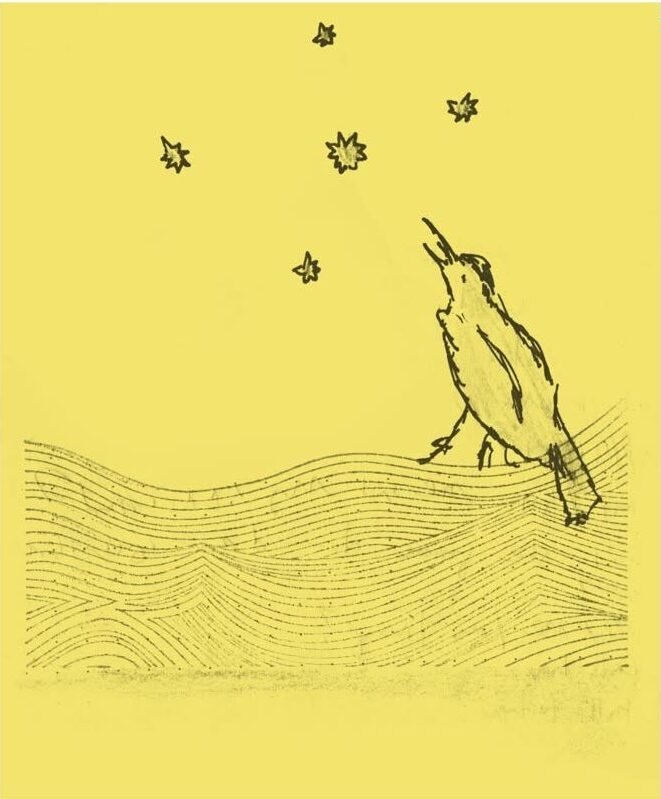
So, again, this book has a lot of drawings in it. Gilbert is not an artist. The drawings seem like something you might expect to see in a therapy journal as opposed to a published work. And some people like that; it gives a raw, amateurish feel to the book. But the issue with these drawings is that there are these very serious, heartfelt moments, like when Liz and Rayya are finally together after years of yearning, and Rayya has this gorgeous quote, “Why did you take so long to come to me?” and you turn the page, and you get: this stupid bird. It’s like a record scratch. “My baby, my beautiful baby, why did you take so long to come to me?” Then: LeBron’s drawing of Bart Simpson.

You also really get the feeling that something is missing here. Gilbert considered deeply what it would be like if she didn’t pursue a romantic relationship with Rayya in this moment, but there was no consideration, at least, written out in the book, of what actually was about to happen. Namely, there was no serious pause to think of what it is like to be a caretaker to a person with terminal cancer. I’m not going to get into the gnarly details, but dying of cancer is not like the movies where someone peacefully takes their final breath, then there’s a shot of a bird in the sky representing their spirit. It is gruesome and brutal. And Gilbert is about to learn that. Gilbert doesn’t have kids, and it doesn’t sound like she’s ever been anyone’s primary caretaker except for some kittens. She is about to get a difficult reality check, but I wanted to point out that I’m not skipping over her consideration of what was about to come; it actually just wasn’t in the book. Maybe it happened in real life, but we didn’t hear about it.
We did then get a full chapter of Gilbert describing what it was like to finally have sex with Rayya. I thought it was lovely, honestly; she talks about how she knew Rayya’s body and preferences and thoughts so intimately, but now finally being with her in this entirely new way felt infinite and transformative. She says that night Rayya felt overwhelmed by a primal energy, so she got up and started pacing circles around Liz because she wanted to protect her energy forever, which, I mean, ok, we all do weird shit when we’re in love; it’s strange but also perhaps the least concerning thing Rayya does in this whole book.
At this point, it was April, and the doctors told Rayya that she would make it to Christmas. Rayya outright rejects any treatment. She says, “No chemo, no radiation, no surgery, no hospitals. No life-extending measures. I don’t mind dying of cancer, but I refuse to be a cancer patient for the rest of my life.” Gilbert then writes that Rayya says she actually liked the idea of dying suddenly. But I also have to remind the reader that both Gilbert and Rayya are unreliable narrators. But at this time, Rayya seems, to Gilbert, exuberant and even ecstatic. She no longer has to worry about gaining weight or quitting cigarettes or working or going to the gym. She felt free of planning for the future, which was something she didn’t really like to do anyway. She says she was just disappointed that she would miss the ending of Game of Thrones.
So the two women decide to live out every single fantasy they had until Christmas. Rayya says, “Let’s live balls to the wall until I die.” Gilbert rents music studios in Detroit and New York so Rayya can record her music. She books out a theater in New York so Rayya can put on a one-woman show. A British filmmaker made a documentary about her. They went out to bars and restaurants and spent every last dime. Gilbert says that during this time she felt “electric” (in italics). She writes,
“My entire body and imagination were thrumming with the prospect of living without any limits or rules whatsoever– of doing whatever the hell we wanted; of throwing off the shackles of respectability and responsibility; of burning up the last few months of Rayya’s life as her literal ‘ride or die’ lover… Somehow we would both be rescued, transformed, and immortalized by the sheer, blasting heat, joy, and liberation of this once-in-a-million-years love story. Christ, it felt amazing! Of course, I should probably also mention that we were high as hell at the time.”
Gilbert then goes on to admit that they were drinking a lot, smoking a lot of medical-grade marijuana, using xanax and Ambien, and taking mushrooms and MDMA. They were also experimenting sexually and trying out expressions of eroticism that she says got more and more extreme.
While Rayya was the one who actually didn’t have a future, Gilbert also started acting as if she had no future. She stopped working on a novel she had been writing for two years, she cancelled all public appearances, she cancelled her podcast that she produced, she stopped calling her friends and family, started the divorce proceedings, stopped exercising, started eating almost exclusively junk, and stopped going outdoors for weeks at a time. Financially, she completely took over Rayya’s life, paying for her treatments, her meals, her rent, her trips, and a series of elaborate gifts. She got her a Range Rover, a piano, a Rolex, Prada boots, and a penthouse apartment on her favorite street in the East Village. She says, “We stopped making love only to make music, food, and art.”
Rayya’s nephew would later ask Gilbert, “Do you remember those early, glittering nights?” And Gilbert says she remembers every second of it. But in the next chapter, she asks, “How high can you fly before you crash?” She then points out that she was dismayed to remember that there were many other people in Rayya’s life besides herself, who loved her, and who were having their own reactions to the diagnosis. These loved ones pushed her to get chemo, and eventually she caved and agreed to get treatment to extend her life. This is when Gilbert first writes that maybe Rayya was, actually, afraid of dying. Rayya said she was just getting the treatment to make her friends and family happy, but the check was also arriving in some other ways. She was starting to experience pain from the cancer: sharp, abdominal pain whenever she moved. And it sounds like that really spooked her. (I almost got the impression that Gilbert thought Rayya would die much sooner, perhaps she would go out like a shooting star in the middle of one of those “glittering nights,” and when that didn’t happen Gilbert started to resent her).
So Rayya starts getting chemo, and the size of the tumors shrank, along with the abdominal pain, but chemo comes with many other side effects, as you may know. She was constantly nauseated and vomiting. She was constantly itchy and couldn’t sleep. She was constantly exhausted, and the steroids made her gain weight. She could no longer do the things that she was doing before, like make love or sing or even walk. So she became depressed and anxious, and would often wake Liz up in the middle of the night to scream, “Am I making all this up? Am I really sick or am I just trying to make people feel sorry for me because I’m a fat, lying, manipulative, lazy asshole?” Gilbert cleaned Rayya, sat with her in the bathroom as she vomited, and brought her Gatorade, toast, cigarettes, and beer. Gilbert says that this process was brutal, but also felt “like a sacred encounter with unconditional love.” At night, Rayya would scream out, telling Gilbert to never leave her. But during the day, when she had more strength and felt more like herself again, she would encourage Liz to take some time away or to find help with caretaking. She told Liz that she was worried she would break down. But Liz refused to get help. She wrote, “I took great pride during those first few months of Rayya’s disease in how good I was at being her caregiver.” She would tell her stories to help her sleep, stay up with her when she couldn’t keep her eyes closed. She wrote, “I had become the very essence of tireless service in the name of love– which was, to be honest, all I had ever wanted to be… I truly felt like an angel.” She says that if the story had ended there, it would have been the most perfect love story ever told. I disagree. But let’s continue.
Gilbert writes that she stopped writing the book at this point for a few months and considered writing a different book, one in which Rayya never “became” an angry and cruel person. She says she wishes that Rayya had “remained” the way that Gilbert saw her before this: “heroic, brave, honest, astonishing, and cool.” This part of the book confused me, because Rayya was never honest with Gilbert “before.” She lied to her habitually. And many of the things that Gilbert perceived as “cool,” like the drugs and her candid nature, were actually tied to immense pain and vulnerability for Rayya. I just always saw Rayya as a traumatized person who used her ra-ra-ra personality and drugs as a front for deep sadness and fear of rejection, but I guess that was never apparent for Gilbert until these moments. Gilbert certainly had Rayya on a pedestal. She idealized her. And there is a dehumanizing element in idealizing someone.
Gilbert shares an email that she wrote to a friend around this time, before things really went south, in which she called Rayya: “my most beautiful story.” She reflects on this email now, saying, “Now, I’m not sure…whether it was even emotionally loving of me to reduce an entire human being down to nothing but a story that I was living in, beautiful or otherwise.” I usually don’t like to read self-criticism; I think it can get tiresome, but I agree with her here. She seems more self-aware now, in hindsight, than perhaps she was in the moment.
Gilbert tells a story after this about a bitter cold day when she went out for a walk alone after becoming overwhelmed with Rayya, and she found an old Ukrainian woman with dementia who had gotten lost and was freezing, so Gilbert held her and warmed her up, then helped her find her way home. But when she got home after helping the Ukrainian woman, she found that Rayya had vomited blood all over the carpet. Rayya yelled at Gilbert, “You were gone too long. I was so afraid. I’m hurting. I’m hurting. I’m hurting. Don’t ever do that again. Don’t ever leave me again.”
Rayya started accusing Gilbert of wanting her to die. She lamented that she was weak, and that her life had been a failure. They hardly ever slept, and Gilbert begged Rayya to let her hire nurses who could at least help her through the night so that she could sleep. They tried hiring nurses, but Rayya would be aggressive to them and tell them that she didn’t want them; she wanted Liz. Even if friends came to help through the night, she would storm past them to wake up Liz and tell her, crying and furious, “I don’t want them. I want you.”
It was the doctors who first prescribed Rayya opioids, just to help her sleep through the night. At first, the morphine helped immensely. Rayya became loving and kind with Gilbert again. The women were able to sleep. But it didn’t take long for Rayya to build up a resistance and start requiring handfuls of morphine pills every hour, to the point where she started screaming at doctors on the phone that she needed something stronger. So they gave her methadone, then they gave her fentanyl. But Rayya said that wasn’t enough, so she started adding coke to the mix; first snorting it, then injecting it. Gilbert paid for Rayya’s coke and picked it up for her. She even registered with the City of New York as an intravenous drug user so she could get needles for Rayya. She tied off Rayya’s arms and legs and held a light for her so she could inject herself with drugs.
Gilbert and Rayya began fighting every day– brutal, screaming, crying fights. Then, the owner of the penthouse that Rayya and Liz were living in wrote to them and told them that they needed to leave. And then, hackers broke into Liz Gilbert’s account and stole all her money. She ended up getting it back, but she had to get the FBI involved. And this is when Gilbert decided that she would kill Rayya.
She writes, “I am not talking here about a mercy killing, or euthanasia, or the arguably courageous act of helping someone who is in great suffering to have a death with dignity. Rayya, at that point, most certainly did not want to die, and she no longer gave a shit about her dignity.”
Rayya was hallucinating through the day and night; seeing hot, itchy bugs under her skin, convincing herself that the cops were spying on them, feeling a demon living in her brain who stole her Rolex, and verbally abusing Gilbert every day. Every time Gilbert fell asleep, Rayya shook her awake. Gilbert says Rayya was losing to addiction and also losing all of the good qualities that she had gained from the years she worked on being sober. Then Gilbert writes,
And who was gonna stop her? Me? The world’s most spineless enabler? The Olympic Codependency Champion of 2017? Little Miss Duck Fluff–a blondie from Connecticut with puppy-dog eyes and a desperate eagerness to be loved and validated and to make everyone happy?
Now, I think she’s mocking herself here, but the self-infantilizing even in hindsight is quite grating. Elizabeth Gilbert is a remarkably, uniquely powerful person. She has more money than most people will ever see; she is a world-renowned celebrity, and now she’s writing, “I can’t stop her from using drugs. I’m blonde! And I’m from Connecticut.” She is, at time of writing, 54 years old.
That said, when we had our book club meeting, I thought that some people on the call made excellent points. First, somebody said, basically, why did the doctors let this happen? Why did they give Rayya those drugs she used to be addicted to and at the same time prepare neither her nor her caregiver for a relapse? And there is actually a doctor in my book club who was on the call, and he has some clinical experience, and he essentially responded by saying, “What exactly are we supposed to do?” Because scenarios like Rayya’s are not uncommon. Many people living with addiction put their bodies through extremely unhealthy, punishing circumstances that, later in life, give them deadly diseases. And there isn’t really scientific consensus on the best way to handle circumstances like this. And the argument that this doctor made was that, given that there is such a dearth of literature about people in this exact situation, the fact that Gilbert is even talking about this is useful and important. One writer on the call who has followed Elizabeth Gilbert and her writing for years just kept repeating: Remember, she didn’t have to write this book. She didn’t have to tell us all of this. And regardless of my writing critiques, I do have to give Gilbert her flowers for that.
Gilbert decides to switch out Rayya’s morphine pills with sleeping pills and cover her with fentanyl patches. She went out to a park to examine the pills so she could switch them and came back to the apartment, excited and proud for having come up with this plan, and Rayya stares her down and says. “Don’t you start plotting against me now, Liz. Think carefully about what you’re about to do.” Gilbert says that Rayya had fantastic intuition and she feels that Rayya could sniff her out. Rayya’s response was like a shock for Gilbert, who then realized that she had hit rock bottom, and she needed to call someone and ask for help.
So she goes back to the park, and she starts calling people and opening up about the situation with Rayya. These friends all give her advice, and one friend tells Gilbert that she thinks she might have a sex and love addiction.
Next chapter is called: Zero Out of Ten Stars. It may have been the worst chapter in the book, in my opinion, aside from the poems and drawings if you count those, because Gilbert, I think, tried to make this part funny, but she ends up sounding kind of like that meme with “quirk chungus”

or that Key and Peele skit where Jordan Peele keeps going “okayyyy?”. Here’s what I mean. Gilbert tries to stage an intervention for Rayya. She did it with no addiction expert, last-minute, no script, no plan, and no car waiting to take her to rehab if she was swayed by the intervention. Rayya was furious with everyone but mostly with Liz Gilbert. Rayya insisted that the doctors had actually prescribed her something called “medical-grade cocaine from a secret research facility in New Jersey.” Rayya also ended up screaming at Gilbert,
“Fuck off, Liz! I had a perfectly good fucking life before you stepped in and took control over everything! I wish we’d never gotten together. You threw yourself at me and I never should have agreed to it. You’re way too much fucking trouble to deal with– just like I always knew you would be. I wish we’d just stayed friends. That way, I could still have access to all the good parts of you, but someone else could deal with all your emotional bullshit.”
So Gilbert runs out of the room sobbing, crying, and everyone else at the intervention is like:

Then Gilbert hits enter and ends the chapter with:
“So yeah.
That went well.”
Her alternative chapter endings:
- AWKWARD.
- #yikes
- Epic. Fail.
So Gilbert calls this a “death blow” to her and Rayya’s relationship, and she moves out and crashes on a friend’s couch. Rayya continues to party in the Penthouse with people who are willing to use with her. Gilbert still paid the bills and spent most of her days crying. Rayya also started talking shit on Gilbert to their friends, saying that she had bailed on her because she couldn’t handle the cancer, so Gilbert starts speaking poorly about Rayya as well.
Then we get a poem in which God says to Gilbert,
“I can see that you are once more trying to convince yourself that you should’ve done better and known better…You are wondering why your mind goes where it goes –
To all those dark and hateful places.
Well, sweetheart,
your mind goes where it goes because you’re an addict.”
Gilbert speaks about “addicts” in this book as if they were a different class of people. She says things like “Everybody feels pain, but for us addicts, that pain is unbearable.” Some people in my book club meeting are in recovery from substance addiction and said they consider recovery to be a big part of their lives, and most of them really did not like this book. And one of the reasons that one person gave was that she felt like Gilbert was excited and proud to be able to consider herself an addict, as if she were happy to have found a justification for all the things that she did. And I think that these moments of writing, when she speaks about people with addictions like they are somehow uniquely attuned to the pains of the world, regardless of whether or not you think that’s true, contribute to that feeling that she might be using her (arguably!) credible diagnosis as a sex addict to maybe write off some things that happened in the past or fit into what she sees as an exclusive in-group.
So Gilbert starts going to a twelve-step program. She also starts taking some more accountability for her actions. She remembers when Rayya once said to a friend who had a brother with addiction problems. “You don’t have a brother anymore.” She writes,
“I felt like I was dealing with two Rayyas here: There was the Rayya of the present, who was a cruel and destructive junkie; and then there was the Rayya of the past, who had spent many years teaching me how to deal with cruel and destructive junkies, in case I should ever encounter one. … That’s some real Obi-Wan Kenobi shit right there, and it was kind of blowing my mind.”
Epic Obi-Wan Kenobi W! This is a very serious novel!
Gilbert again thinks about Earth School and realizes that she has to face down Rayya and leave her.
So she called Rayya and asked to speak for ten minutes, and Rayya agreed. Rayya sent away the people she had been partying with, and Gilbert arrived to find the penthouse was completely trashed. Rayya was muttering to herself, pacing, tugging at her hair. Gilbert made herself a coffee, and sat down, and told Rayya to do whatever she needed to do substance-wise, to be present enough for this conversation. So Rayya went to the bathroom and came back, and the women held hands, and Gilbert said, “Rayya. I need to let you know that I can’t be in this story anymore. It’s doing too much damage to me.” Gilbert acknowledges and apologizes for her part in creating this mess of a relationship. She tells Rayya that it matters how a person dies, and she tells Rayya that she’s lost all her integrity and greatness. She tells Rayya she’s abusive and that if the “real Rayya” were there, she would kill anybody who treated Liz like that. Then she tells Rayya that she’s kicking her out. She needs to go. Gilbert says she’s getting her own place and Rayya is the one who needs to figure out where to live. Rayya responds, “But I’m dying. You can’t abandon someone who’s dying.” Gilbert replies:
“I hear you, and I accept that you’re dying. I’ve been preparing for months to say goodbye to you. But this might be the moment when we have to say our goodbyes, because I won’t stick around for what you’ve gotten yourself into.”
Gilbert then tells Rayya that she loves her and she always will, but she can’t be with her anymore. Rayya at first is silent, then says. “Okay, man. I hear you.” Gilbert replies, “Thanks, man.” They hug and tell each other, “We’re good,” and Gilbert walks away.
Rayya, after she loses her home and her girlfriend in her final months of life, is in active addiction and has no options. So she calls her ex-girlfriend, Stacey. They actually dated when Rayya was in active addiction the first time, but after Rayya got sober and mellowed out, she and Stacey reconnected and became dear friends.
So Rayya called her ex Stacey and said, “I need your help.” She told the whole story, and Stacey said, “Tell me what drugs you’re on and don’t you dare bullshit me, or I’ll hang up on you.” Rayya told her. Stacey said, “What do you want me to do about all this?” Rayya said, “I want you to help me get clean.” Stacey lived in Detroit, where Rayya had grown up, so she told her, “If you can get yourself to Detroit without dying or getting arrested, and if you’re really serious about this, I’ll help you. But I’m only giving you one chance.” And she hung up. As the reader at this point, I felt like: Finally, a fucking adult. Right around here is when the book starts to get better, I think. We still have the rough poems and drawings, but the storytelling chapters feel like less of a slog.
Rayya filled her suitcase with drugs and, high out of her mind, somehow managed to fly to Detroit and show up at Stacey’s door. Stacey wouldn’t let her in unless she turned over all drugs, illegal and prescribed, and told Rayya that she would be administering her pharmaceuticals from now on. Rayya at first refused, and Stacey said, “You can’t manipulate me the way you used to, or the way you’ve been manipulating Liz and her family lately. Frankly, I don’t have the same level of emotional investment in you.”
So Rayya agrees, turns over the drugs, and Stacey lets her in. Gilbert writes, “What Stacey ended up running out of her home in early autumn of 2017 was basically a private rehab clinic plus a hospice center.” She describes how Stacey stayed up through the night to care for Rayya as she went through detox. She administered the right doses of drugs and flushed the rest. She brought Rayya to doctor’s appointments. She got hospice nurses and social workers to come over every few days and help. She gave Rayya food, and she got her to hydrate, and Gilbert was bitterly jealous. Stacey called Gilbert every day to keep her updated, but she would not let her come visit. She said, “It might be better for everyone involved if you were not around Rayya at this very moment.”
In my book club, someone on the call said that he wished Stacey was in more of the book, because if Gilbert showed us how not to handle circumstances like this, then it would have been cool to read more about how Stacey handled it so well. But I understand that Gilbert wasn’t there… at Stacey’s behest.
After Rayya went through detox and sobered up, Stacey let her call Liz Gilbert. Rayya was chipper and lucid, which made Gilbert feel like she was losing her mind. Gilbert was hoping that Rayya would apologize and cry and beg for forgiveness, but instead, Rayya said that she had zero recollection of the whole time she was using. She says that she was with Liz, and they were living together and in love, then one day she woke up at Stacey’s house with no memories of anything she had done or said in the last few months. Gilbert was enraged by this, but also deeply grateful to Stacey for the way she had stepped up when they both needed it. I have never been on as many drugs as Rayya was, but I have to doubt this claim tha she doesn’t remember a thing. Really, not a single memory from the whole time you were doing drugs in the penthouse; I mean, how convenient.
At the end of autumn in 2017, Stacey gives the lovebirds permission to see each other again. She warns Gilbert before she arrives that Rayya is starting to have cognitive symptoms, so she might not be as Gilbert remembered her. When Gilbert arrived, Rayya was in rough shape. The tumors were now visible on her torso, and she had become very thin due to the tumors consuming the nutrients she ate. But Gilbert writes, “Still, she was gorgeous. Rayya had always been beautiful, but now she was luminous. Newborns have that look, too, and sometimes the very elderly, and the dying. It is the look of someone who has recently arrived here, or who is soon to go home– the light of another world shining through.” I loved that and found myself thinking about it for months after. The way that Gilbert jumps between expert writing and cringey meme writing really gives me whiplash.
At first, things felt awkward between Rayya and Gilbert. They asked each other small-talk sorts of questions. Eventually, they got some privacy, and Rayya started telling Gilbert about the experience of dying. She said every night, either her mother or father, who were both deceased at this point, would come to visit her in her dreams. On one hand, it was comforting to see them again, but she said it also filled her with fear, because she knew why they were there, and she didn’t want to go to the other side with them yet. She also saw her grandmother in her dreams, who spoke to her in Aramaic, which Rayya hardly understood, and she was visited by ancestors whom she only recognized from photographs. She had a dream where her father was on his deathbed in the hospital, but he woke up and called her over, and he said that she should never let anyone tell her that she’s a bad person, because she is extraordinary. But Rayya rejected that thought, saying, “But look at all the bad things I did.” Recounting the story to Gilbert, Rayya bursts into tears and finally apologizes. She says that she fucked everything up between them, and she had such a short amount of time to be with Gilbert, and she wasted it all away.
In this moment of tearful confession, Gilbert also confesses to Rayya that she tried to murder her. Rayya says, “That’s badass!… That’s fucking awesome! That’s amazing! I’m so proud of you!” They both start to laugh, and Gilbert says, “Wait, why are you proud of me?” And Rayya replies, “Because you found your darkness, dude!” Gilbert says, “Well, you really bring it forth in me.” And Rayya gives her a fist bump. I got the impression that Rayya was kind of relieved to not be the only person who did fucked up things in the relationship. Then Liz says that they need to talk about what actually happened between them so she can get it off her chest, and she proceeds to tell Rayya everything that she did and said. Rayya is not surprised, because she says, “That’s who I become when I’m a drug addict.” Rayya then says that if they had more time, then she would go through all the steps of recovery and promises and do all the work and make all the apologies necessary to win Liz back. But she says, bluntly, that they don’t have that kind of time, so she just needs to know if Liz can forgive her, and Liz says she can, and Rayya also forgives her, and they fall asleep together “holding hands like children.”
Gilbert writes that Rayya described “a gathering” happening on the other side: a coming-together of ancestors and deceased loved ones getting ready to welcome her to the afterlife. Gilbert writes that a gathering was taking place in this world, as well, with the living coming together to say goodbye to Rayya and see her off. But Rayya was also back home again and that came with its own family tensions and uncomfortable moments. Gilbert writes, “
“There were some really big personalities in the room, and I would love to say that we were all supportive and gracious with each other as we faced our own suffering and each other’s, but I can only report that sometimes we were supportive and gracious and sometimes we were not.
Sometimes grief can look like rage, as it turns out.
Sometimes grief can look like territorialism, jealousy, and blame.”
Around this time in the book, Gilbert describes a sister of Rayya’s cooking enormous, fragrant, Syrian meals for everybody that their mother used to make. I don’t know if this is the same sister, but The New York Times did report that one sister of Rayya’s was not happy with this book and the way that it exposed Rayya. Alexandra Alter with The New York Times writes,
“In an interview, Elias’s sister…questioned some of the details, particularly the timeline of when Elias began to relapse, and said other parts felt embellished and exploitative, like when Gilbert detailed all the money she spent on Elias.”
Then we have a quote from this sister:
“We all knew from Day 1 that a book was going to be written and money was going to be made out of my sister’s death. To me, Rayya should not be on display.”
If it’s true that the family knew from day one of Rayya’s relationship with Gilbert that Gilbert would write a book about her someday, then I could see where tensions might arise in these final days of Rayya’s life when they are all essentially living in one house. But Gilbert writes that before the book was published, she did visit one of Rayya’s sisters, Maha, who I guess would be a different sister than the one quoted in The Times, and Maha forgave Gilbert for how she acted in those final days, saying, “We were all drowning.”
Rayya’s lucidity was fading, so she would sometimes seem very aware of her own death, then other times she would call friends and make plans for “when we’re back in New York.” Then Gilbert wrote my favorite part of the whole book:
“It was around this time that I began to understand at a much deeper level what it means to die–how you really do lose everything. I began to feel in my own heart all the things Rayya would never do again. She would never drive a car again, or cook a meal for herself again, or be able to bathe or shower alone. she would never see another summer’s day. She would never play the piano again. She would never get on an airplane again and head off on a new adventure. She would never make love again. She would never walk outside by herself again. She would never write another song. I was losing her, yes, but she was losing everything, everything, everything.”
It’s writing like that that gives you a newfound appreciation for life even in the most mundane moments. Gilbert told The New York Times that these chapters, when Rayya passed, were the hardest for her to write, and she would often take long breaks to walk and cry and process what she was putting on paper. So I’m grateful to her for going through that process and still coming back to write about Rayya’s death with a lot of tenderness.
The two women rely on their spirituality around this time a lot, praying together. Rayya’s prayers start to lift off the ground, becoming more dreamy and beautifully articulated. She says that dying like this is a burden, but it’s also an honor, and in her prayers she thanks God for that honor. There was a moment when Gilbert thought that Rayya would die, so she called in her ex-girlfriends, and the four women lay down in bed together, and they lit candles and put on music, then Rayya woke up and was like, “Why are you guys being so weird. Anyways, there’s a sale at Lulu Lemon I wanna hit,” and one of the exes quickly blew out all the candles so they could take her to buy leggings. But when it came time to actually die, Rayya was in a lot of pain, and refused to let go. Gilbert writes, “I watched you die for 48 hours, Rayya.” But when Rayya finally took her final breath, her face settled into an expression that can only be described as ecstasy. Gilbert then addresses Rayya, writing,
“My love, do you remember how I stayed with your body for hours after you took your last breath? Do you remember that part?
Do you remember how you’d made me promise a few weeks earlier that I wouldn’t leave your body alone after you died? And so I stayed there in the bed with you–holding you and kissing you and telling you stories…
‘What a ride you took us on, Rayya,’ I told you–and I could hear your laughter.
We washed your still-warm body–these exhausted women, who all loved you so much. We put clean clothes on you. Your sister and I joined hands and prayed over you. Somebody called the funeral home… Do you remember that part, Rayya?
Did you see your own body as we took care of you?…
Did you hear us talking about you, Rayya, or were you already gone?
Were you still with us at that point, my love?
Or were you already with them?”
I can’t help but feel that Gilbert is doing important work here. We all die. Most of us will probably witness death at some point, and yet death is such a taboo topic. So in writing about this, and in sharing these moments with us, that I know were extremely difficult to write, Elizabeth Gilbert is working against that taboo and sharing critical information with readers who may find themselves someday in a similar scenario.
Then Gilbert describes some memories. A week before Rayya’s cancer diagnosis, it was her 56th birthday, so Gilbert rented her a place on the Jersey Shore, and they invited friends to come celebrate her. But they wanted time alone, so they went a day early to set up and get alone time together and write music. They were not lovers at this point. The next morning, Rayya said she wanted to make a birthday cake, so they made a big cake from scratch; then at 10:30 in the morning, before any of the party guests were there, Rayya said, “Dude, let’s just eat this fucking cake right now.” Then Gilbert started laughing and couldn’t stop; then, as she describes it, the ghost of Rayya’s mother suddenly channeled her. So she got goosebumps and chills and said, “Rayya, your mother’s here.” Then she started sobbing and saying, “Your mom is here and she wants me to tell you that she loves you so much. She’s so proud of you, habibi.”
So they both laugh and cry and hug, then they eat the whole cake, and Gilbert says that it was the “best cake ever,” and one week later, Rayya found out she was dying. Then Gilbert describes one night when Rayya was suffering terrible side effects of chemo, and the ghost of Rayya’s mom asked to inhabit Gilbert’s body again, this time to say that she wanted to hold and kiss her baby, so Gilbert allowed her to enter her body and hold Rayya and kiss her. One part of this lore is that Rayya’s mom passed while Rayya was still in active addiction, so I’m sure that Rayya had some trauma and guilt there related to her relationship with her mother. She says that after Rayya’s mom’s spirit kissed her forehead once, Rayya finally fell asleep. The other memory of Rayya’s mother that Gilbert shares is that she kept appearing in Rayya’s dreams before she passed, telling her to take her hand, and Rayya would wake up crying and distraught because she wanted to hold her mother’s hand, but she couldn’t because she knew what it would mean– it would mean that her mom would take her to the other side. Finally, Rayya had a dream when she actually did try to take her mother’s hand, but she found she couldn’t. So she asked her mom what she needed to do, if she needed to fight to cross to the other side or break through with force. Her mom said, “Habibi, where you are going, there is no more fighting. It’s easy, my love. Just take my hand.” Rayya still was unable to take her hand in that dream, but she passed away two days later, so she must have figured out how.
(I have noticed that when people who are not Spanish-speakers write books about Spanish-speaking characters, they overuse the word mijo, and when people who are not Arabic-speakers write books with Arabic-speaking characters, they overuse the word habibi.)
So Gilbert moves back to New York to try to rebuild her life after Rayya. Stacey gives Gilbert the number of a psychic medium named Lori in Birmingham, Michigan. Gilbert describes Lori as “a sweet-faced, blond, middle-aged suburban woman in clogs and comfortable dress, whose office was decorated with butterflies and dream catchers.” As soon as Gilbert sees her, she breaks down in her arms, then lies down on the couch and asks Lori to tuck her in like her mommy, but I’m not gonna make any jokes about that because she’s grieving and we’re all a little cooky when we’re grieving, plus I’m picturing Lori like this lady and I would also like to be tucked in by this lady. Her blanket would definitely smell like cigarettes, but it would be so comfy.

So Rayya starts to speak to Gilbert through Lori, and she first tells her that she can communicate with her by herself; she doesn’t need to waste money on a psychic, which made Lori laugh. She also said that she had suffered a horrible, violent death, but the reason her death was so hard was because she refused to let go, because she didn’t believe there was anything on the other side. But now she’s learned that there is something on the other side, and it’s more beautiful than she could ever explain, and the best way she can describe it is that she’s become music now. She says to not be afraid of death, because it’s beautiful, and she promises that when it’s Gilbert’s time to die, that she, Rayya, will be the one to come get her. Gilbert bursts into tears and tells Rayya to come get her now, but Rayya says she can’t, because it’s not her time. Gilbert is still curious about why Rayya smiled that big smile right before she died, and what she saw that made her happy like that. And Lori responds that the last thing Rayya saw before dying was her own mother smiling at her and saying, “Take my hand.” And of course, there was really no way for Lori to have known about all those dreams Rayya told Gilbert about; Gilbert hadn’t mentioned it– it was just a specific detail that came organically from Lori.
So now, Gilbert is not in a good spot. First, she’s out of money. The divorce, plus her hiatus from work, plus her haphazard spending before Rayya died has emptied her account. Second, along with grieving Rayya and overcoming all the trauma, she’s also grieving a ten-year marriage, a divorce which, it sounds like, she hasn’t processed. She also has stopped going to her programs for sex and love addiction– she says that once Rayya got clean and started being nice to her again, she no longer felt like she needed help for sex and love addiction. Her professional relationships have been suffering as well, because she has a novel that she was supposed to turn in one year ago that she has not yet started to write.
So the first thing she does is call her agent and ask her to fill her schedule with speaking events so she can go give life and creativity advice to people. Just two and a half weeks after Rayya died, Gilbert was already doing speaking events. Her publisher gave her six months to finish her novel, City of Girls, and she wrote furiously, completing 3,000 words per day and finishing her book in about six months– for reference for the non-writers among us, those are Stephen King numbers. The book, by the way, was historical fiction about a bunch of New York City showgirls in the 1940s who “really loved having sex,” which was not what Gilbert wanted to be creating in the wake of her partner’s traumatic, painful death, but she was hyper-productive regardless. As she wrote, she lived in the church where Rayya had lived, and she wore Rayya’s clothes and ate her food out of the freezer and spoke to Rayya constantly, and heard her speak back. She writes, “It was a very weird summer. ‘Weird’ in the Shakespearean sense of the word. Eerie and haunted.” For example, neighbors moved in next door, and they had little kids and a dog named Rayya. So as Gilbert worked, she would hear the kids calling out, “Rayya! Rayya!”
Gilbert says she was sad about Rayya but also enraged with her. Rayya had promised significant financial gifts to friends that Gilbert now had to pay off. She also paid off huge credit card bills that Rayya had racked up.
Then, the next chapter starts with this line:
“I took a lot of psychedelic drugs during the year after Rayya died.
Like–lots and lots of psychedelic drugs.”
I read that line, I said out loud, “Ohhhhh, “ because I think that can explain part of what happened to her writing style and her prose. Let’s put a pin in that.
So while Gilbert is living alone in this church, she is taking so many drugs that she hallucinates constantly. She saw Rayya as a big white tiger, as purple orbs, as a white vibrating line representing music. Sometimes she actually became Rayya and felt her pain from cancer. She once took ayahuasca and– interjection talked to Rayya’s cancer cells, who she says arrived in “a sheepish, shuffling cluster.” And they said (high-pitched voice), “We hate our job of being cancer! But it’s our destiny.” At one point she has a vision of an alternate universe in which she and Rayya became a couple not long after they met, and Eat, Pray, Love never happened, and Rayya was still alive, and they had a modest apartment in the East Village where they lived a humble, happy, sober life. And this vision felt so real that the next day she drove to where the apartment was in this vision; she remembered because she saw a specific cafe out the window, and in this universe there was just an empty lot, and she stood on the street and cried and cried and cried. And honestly, could she have handled this better? Sure, but if I sat here and said that I would handle it better if my spouse died, then I would probably be lying to you. So, no critiques about this part either; it’s honestly just really sad that she went through this.
So around this time, Gilbert also started succumbing in a dramatic and desperate way to her sex and love addiction. It was publicly shared around this time that she was dating an ex-roommate and best friend of Rayya’s who was a photographer, but she doesn’t address that in the book. In fact, she says that she simply does not have the heart to write about the details of what she did around this time and who she was with sexually and romantically. But it ended with so much distress and drama that she decided to go back to her twelve-step programs. In these twelve-step programs, she listens to people who have blown up marriage after marriage because of their addiction, people who lived through the same childhood trauma that Gilbert did, people who ruined other people’s marriages, other people’s relationships, because of their sex addiction, people who couldn’t keep a job because they would sleep with people at work, or who couldn’t keep their money because as soon as it hit their account they were spending it all on that special someone. She has an awkward experience in one of these sex and love addicts anonymous meetings when two girls get excited and run up to her and say they’re her biggest fans and they can’t believe they’re seeing her there in a sex addicts anonymous meeting. She feels very exposed because she’s been sharing very personal memories and moments in these meetings, but she’s a public figure, so she gets recognized every once in a while. But she decides to go back and keep going to the meetings because she needs this; she needs to recover.
So she gets a sponsor, and the first step is that she has to go no-contact with anyone she’s crushing on or interested in or talking to or even thinking about. She deleted a bunch of attractive people on social media. She also threw away a lot of Rayya’s things.
She said her life started to feel deadly boring, to the point where she felt like crawling out of her skin. So she tried to replace her restlessness with healthy habits like working out and eating well. One thing that happens when you get sober is that you aren’t just dealing with the difficulty of quitting your substance of choice, but all the things that you previously dealt with through substances start to come bubbling to the surface, and they’re still unresolved because you’ve been using substances (or in Gilbert’s case, sex and love) to escape those difficult feelings. And now you can’t escape them. So she finds herself confronted head-on by uncomfortable and disturbing situations from her past, which she calls “ancient suffering.” After she gets her first sobriety chip, she starts going to meetings constantly, multiple times a day– she seems to have an obsessive personality.
She would frequently get crushes on the people whom she met in these rooms, at which point her sponsor would gently tell her to stop going to that room. Although it wasn’t her intention, Gilbert also stopped drinking around this time, then she quit using drugs. She also hired a “financial therapist” who helped her develop healthier spending habits. After a year sober from sex and love, she found herself capable of meditating for hours and every day, drawing and writing poetry. She stopped getting botox. The pandemic came around this time, and Gilbert became more like a monk or a recluse, throwing herself into her creativity. She wrote, “And then, one miraculous afternoon when the world was completely shut down and I was more alone with myself than I have ever been, I looked up and realized that I had somehow slid into the most peaceful, creative, happy, and spiritually rich season of my life– and I’d never seen it coming.”
Although celibacy is not required in these programs, Gilbert chose to remain celibate. She shaved her head around this time, and she writes, “Rayya would have hated this haircut on me, by the way. She liked her women to be soft and pretty and traditionally feminine. You know who else likes their women to be soft and pretty and traditionally feminine? Almost everybody in the world, as it turns out. But lately I find that I do not care.” She has a plan that she made with her sponsor for if she wants to have sex again, what requirements she must follow to make sure that it’s healthy, but she hasn’t dated anyone else yet. She writes: “Whenever I ask the God of my understanding if it’s time for me to start dating again, the answer usually comes back the same: Lol no.”
Then she tells a story about when she is teaching a course at a spiritual retreat center on a tropical island. One of the rules in Gilbert’s dating plan is that she can’t fall in love with someone when she’s traveling, because that’s not “the real them” on vacation. But there was another teacher who was really sexy, and Gilbert was attracted to him as soon as she saw him. And he was looking, too; he also liked what he saw. Then she gave a speech that received a standing ovation, and she could see him impressed in the audience, and that night she went back to her room, and she got a text from the handsome man. He said, “I’d like to invite you down to the beach for a late-night drink. The stars are out, it’s a gorgeous night, and I want to get to know you better. I really hope you’ll say yes, because otherwise I’d be doomed to stay down here by the ocean all alone thinking to myself, ‘Elizabeth Gilbert is beautiful and amazing.’” Then Gilbert writes, “Instantly upon reading these words, a bitch forgot she doesn’t drink.” I find it cringey when she talks like that. I know it’s supposed to be funny, but maybe it’s her age; maybe I like my books to feel a little bit more like books, but she’s such a pretty writer that when she tries to insert one-liners that sound like TannerTan. So she gets this text and she immediately starts getting ready to go meet him without thinking about it. And she puts her hand on the doorknob, and she realizes what she’s doing, and she stops. She has a conversation with God, in which God says, “That is not your man, honey,” and after protesting and arguing with God and with Rayya’s disembodied voice, she finally cedes and turns off her phone and goes back to bed. She avoids him for the rest of the retreat even though she really doesn’t want to, and three months later, in the group chat with all the teachers from this retreat, the man shares a photo of his beautiful baby boy who was just born to his gorgeous young wife. So while he was trying to sleep with the author of Eat, Pray, Love, his wife was six months pregnant.
So then Gilbert writes a full chapter about her inner child. She now calls her inner child Lizzy, and she says that Lizzy is everything to her, and her primary goal in life is making sure Lizzy is safe and calm and happy and loved, which is nice, you know, that’s nice. She also has an ongoing relationship with Rayya, and the only thing she wants from Rayya is that she be free. She repeats a prayer they say in her twelve-step programs, which is, “Dear God– thank you for all that has been given, for all that has been taken away, and for all that remains.” I felt like she didn’t know how to end this book because she ends it a few times. There is one poem for Rayya:
A POEM FOR RAYYA, SIX YEARS GONE
“Baby–do you remember that night when you said:
We’re both walking a brave path right here.
I have to be brave enough to die,
and you have to be brave enough to live.
Even, then we couldn’t figure out who had the tougher job.
(In the end, you decided it was all right–
because you’d always been fascinated by
death,
and I’d always been fascinated by life.)
So you left, and I stayed.
And now that it’s all over,
I just want to say:
My friend,
my wife,
my most complicated story–
I’ve put my sobriety chips on the bookshelf,
right next to yours.
You had thirteen years of these.
I only have some.
I had to stay because I’m just beginning.
You had to leave because you’re done.”
And a drawing that says, “Come in, sit down– it’s over.”:
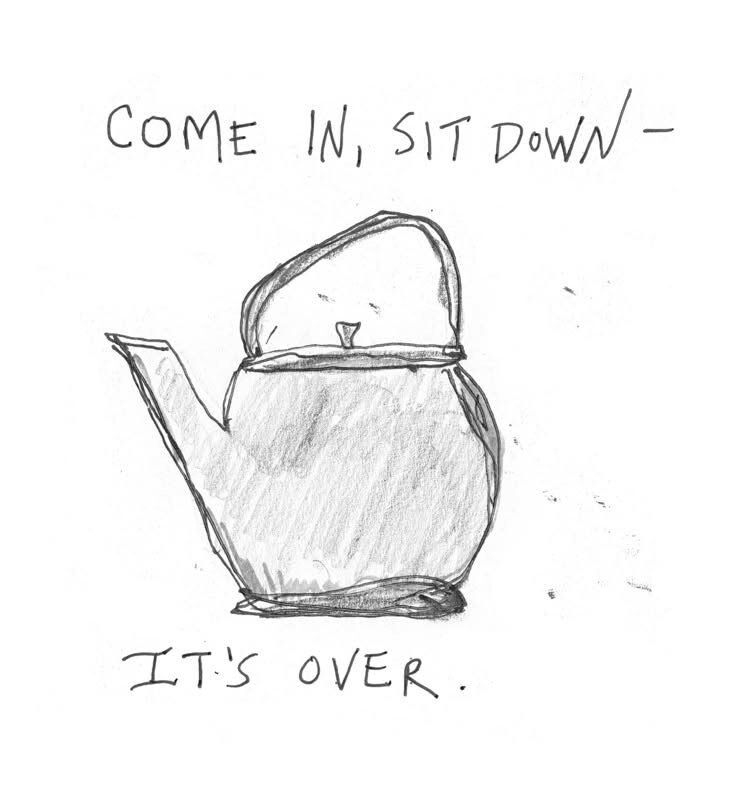
Then another poem, this one from Rayya:
AFTER ALL THIS, RAYYA WOULD LIKE TO RESPOND
I love it when you talk about me:
It polishes me like a diamond.
And when you talk to me,
it’s like I’m drifting in a rowboat on a warm
lake
with my hand trailing in the water–
and then something comes up from below
and bumps against the boat.
(But it’s a gentle something–harmless and
soft like a manatee.)
I can’t always hear your words, my love–
But I can feel them,
and they take me out of my dreaming.
You’re wondering if you ever disturb me by
talking with me so much–
but it’s not like that where I am.
You’re wondering what it is like where I am–
but all I can do is put the question back to you:
What’s it like where you are?
Because where you are is where I am.
All of us together, is actually what it feels like
here.
My love for you, the lake.
Your love for me, the boat.
The days stretch on forever.
And the heart knows who it belongs to.”
Then another drawing, and another drawing that says, “Next year is next year’s problem”:

We did it, we did it through. Okay. Let’s discuss.
Review
Catharsis
You might know that the Ancient Greeks used to do physical cleanses and purges in the baths, for example, by sweating in a sauna or hot spring and letting all those toxins out. But did you know that the ancient Greeks also did emotional purges? In theater festivals, they used to watch three tragedies in a row so everyone could cry and keen and grieve; then they would end the day with a satyr, which was a short, irreverent comedy, so everyone could close the day laughing. In Aristotle’s work Poetics, he theorizes about why it can feel so cleansing, so healing, and ultimately so good to watch a tragic play. We watch Oedipus accidentally fuck his mom, then gouge out his own eyes, and then we’re like, ahhh, I just feel so peaceful. You know that feeling when you walk out of the movie theater, and it’s dark outside now, and you start seeing things differently, and your brain feels so intellectually stimulated and active, yet so calm. Aristotle coined the term “catharsis” to explain this process: a purge of emotions like pity and fear. He theorizes that by watching this tragic work of art, you had the opportunity to release emotions that you had been holding in during your real, personal life.
But catharsis can only take place if a work of art is created very, very particularly. Think about the sauna as an example. If the sauna is too hot, or if the work of art is too disturbing and too real, then people don’t even want to go in the sauna, just like they wouldn’t want to engage with that work of art. If the sauna isn’t hot enough, or if the work of art doesn’t feel real or sad enough, then the sauna is just a muggy room, and it makes people uncomfortable, and the work of art just feels corny and forced; like it’s trying to make you cry, but not quite getting there.
My mom was first diagnosed with multiple types of cancer when I was 20, then unfortunately had another recurrence just a few months ago. I’m sure many of you watching have also had these close encounters with cancer, through yourself, or a loved one; it’s unbelievable how many people that disease touches.
As a result of my personal experiences, I have high standards for art that deals with cancer. Because if I’m reading something entertaining, then I can escape my real life– I can’t do that if I’m reading about something related to cancer, because that book will remind me at every turn about my real life. And that is fine… if that work is so well-written that catharsis takes place. But as I said, in order for catharsis to take place, the author has to strike a very particular balance. The emotional dealings have to be just so, like Goldilocks’ porridge, or the perfect sauna. I feel like, if the author is gonna take me there, to the point where I’m thinking about these very real, very painful topics, then I want them to have the skill to write something so beautiful, and so true, that I can end the day laughing at a satyr. I can get lost in the process; that feeling of: yes, life is difficult, but at least we have poetry.
My desire for catharsis, plus the fact that Elizabeth Gilbert is such a celebrated author, meant that I was going into this book with very high standards for the quality of the book as a piece of literature. So imagine going through the beginnings of the emotional process of being reminded of mortality, of cancer, of caretaking, and you flip the page hoping for some level of emotional release, and what you find is the following poem:
Your name is Somebody.
Somebody here needs to change.
Your name is Somebody.
So that’s a two-line poem from a career writer in which the title of the poem is the second line. Instead of catharsis taking place, the reader’s emotions get stunted, and it feels like a zit that didn’t pop or sex without an orgasm– it’s like, if you weren’t going to finish the job, I would’ve preferred if you never started in the first place. Because now those suppressed emotions from my real life are at the surface, but not released.
In this review, I am trying to focus on a critique of the book’s writing more than I am focusing on Gilbert’s personal decisions. There are a few reasons for that. (1) I think that the marketing of this book, either intentionally or unintentionally, dramatized the events that happened in the book and, in some cases, maybe even misled readers, and (2) if your book is very well-written, you can put the writers in your shoes and they can empathize with nearly anything. So while I do think that Gilbert made many bad decisions in this book, and I think she would agree, I only intend to comment on them when I think that they ultimately ended up hurting the quality of the writing in the book.
So let’s first talk a bit about the way that this book was marketed and how, in some ways, we were sort of sold a lie. In the portion of this book in The Cut, which Elizabeth Gilbert wrote, the ending of the story was her giving Rayya a long speech in which she says, “I hear you and I accept that you’re dying. I’ve been preparing for months to say good-bye to you. But this might be the moment when we have to say our good-byes because I won’t stick around for what you’ve gotten yourself into. …I wanted to walk all the way to the river with you, but that might not be possible for us anymore because I can’t survive the way you’re alive. It’s too costly for me. It’s too degrading to my soul,” and then she leaves her; she walks away, “shaken but straight-spined.” So that portion, published in The Cut, almost made it sound like Gilbert used Rayya for a few fun months of partying and then just abandoned her. But when you read the book, first of all, you’ve seen Elizabeth Gilbert explore many other caring options and you feel how her hands are tied in that moment, so you empathize more with the decision even if you disagree with it, and you also read on to find out that the two women ultimately get back together– it wasn’t like she used her up for a good plot then abandoned her forever. They were two very flawed and often immature women, but I do think that they loved each other.
The other weird thing about the marketing campaign for this book is that there was a lot of emphasis placed on the fact that Elizabeth Gilbert planned to kill Rayya at one point. A reminder, Tolentino wrote in his review:
“Losing the faith, [Gilbert] decides to murder Rayya, literally, by switching her morphine pills with sleeping pills and covering her in fentanyl patches—a plot that fails only because Rayya somewhat demonically cottons on to the plan and thwarts it.”
I read that quote, and I thought that Elizabeth Gilbert physically covered Rayya in fentanyl patches. The following quote from Elizabeth Gilbert was also published in Instagram posts from The New York Times :
“I’m the nice lady who wrote Eat, Pray, Love. And I came very close to premeditatedly and cold-bloodedly murdering my partner because she had taken her affection away from me, and because I was extremely tired.”
Then you read the book, and you realize that it’s not technically correct to say that she attempted to murder Rayya; she thought about killing Rayya. So when I got to that part in the book, I actually went back into my previous video and changed the title from “Elizabeth Gilbert tried to kill her girlfriend” to “Elizabeth Gilbert planned to kill her girlfriend,” and I cut out portions of the video to the point where people were commenting like, “Is part of this video missing?” Then I got to the end of the book, and Gilbert herself writes that she told Rayya that she “tried to” kill her, so now I’m like, pause, how far did this plot get? Did it get farther than thinking and you’re trying to cover your tracks, or did we exaggerate what actually happened in the marketing materials so that we could sell a more dramatic story?
Publishers know as well as you and I that if a book has more dramatic or salacious elements, then it will sell more copies. And I understand that, someone in my book club made the point that you can’t think that writing and art are important, difficult, and worthwhile, and also think that artists don’t deserve to make good money off their art. Those ideas are mutually exclusive. But I think that the decision to focus so much on Elizabeth Gilbert’s plot to kill Rayya when they were selling this book was at best strange and at worst kind of exploitative toward Rayya. I don’t know how much of a say Gilbert had in how his book was marketed. But I will say that, and this is often the case with very financially successful women, Gilbert is probably more of a businesswoman than we might intuitively give her credit for. In interviews and in her books, she almost has this person who floats through life and has her head in the clouds, but Gilbert doesn’t just know how to write books; she knows how to sell books.
I’ll give you an example: I saw an interview with Elizabeth Gilbert in which she talked about people coming up to her at book signings after Eat, Pray, Love and saying, “Wow, I wish I could just drop everything and go travel the world buuuut, xyz, I’m a caretaker, I’m paycheck-to-paycheck, etc.” and Gilbert said that she always responds to them to say, “But you can do it. You can be like me.” She also wrote in Eat, Pray, Love that she bankrolled her trip by selling everything she owned and living frugally off her savings. Then again, in All the Way to the River, that she went on that trip because she was “following the voice of God.” But… that’s not the whole story. The part of Eat, Pray, Love that often gets left out is that her trip was funded by a $200,000 advance from her publisher. I think that Gilbert deserved that money in the sense that she had already provided herself as a writer plus Penguin made dividends off that initial investment; it was a wise and forward-thinking investment on their part. But this version of Eat, Pray, Love, where a brave lady packs a bag and fucks off on a cloud to eat gelato, is more fiction than might initially meet the eye. And maybe the All the Way to the River equivalent here is that publishers and Gilbert decided to sell this narrative of: She was a nice author lady until she got a taste for blood, and to be fair, it seems like it worked; I mean, I read the book out of morbid curiosity, and it was on the nonfiction bestseller list.
But I wanted to include an important caveat that, if it is true that Gilbert only thought about murdering Rayya, then I really want to avoid criticizing her for those thoughts, and I’ll tell you why. First, thoughts of hurting the person whom you’re caring for are unfortunately a very common symptom of caregiver burnout, and if you’re a caregiver for someone and you have thoughts like that, I want you to know that you’re not a freak or a monster, but you should seek support, and I’ll leave some resources at the end of this article. Second, when my family member whom I mentioned was going through cancer the first time, I started experiencing intrusive thoughts. My intrusive thoughts were focused more on myself and my own body than they were on other people, but there is perhaps something about watching someone very genetically similar to you going through something so physical and focused on their body that can trigger disturbing intrusive thoughts. And if someone is having thoughts like that, one of the worst things you can do is try to stop them by telling them what they are or are not allowed to think. So I am personally very against thought policing; in a religious context, in a relationship, in art. Because if you have an intrusive thought and you think, Eh, random neurons firing. Happens to everyone. Then often the thought doesn’t stick as much as if you have an intrusive thought and you think: What is wrong with me? What kind of sadist would think of something like that? So thought policing and thought punishing are counterproductive. I say this not necessarily for Elizabeth Gilbert’s sake, but for the sake of anyone who might be watching this or who might be seeing the marketing of this book and thinking, “Everyone hates Elizabeth Gilbert because she thought about killing somebody and I thought about killing somebody, I must be a bad person.” In reality, and despite what this book’s marketing framed it as: doing something and thinking something are very different. There is also the possibility that Elizabeth Gilbert did make more progress in her plan than she wrote about, and she’s hinting at it with these quotes about “coming very close” to killing Rayya, but either way, we will never know, so we can only judge the events of this book based on the little window into her life that Gilbert opened up for us.
As I said earlier, the other reason that I want to stray from criticizing his own personal actions has to do with two questions that a college professor used to ask our class anytime we finished a new book. First, he would ask, “Did you like it?” Then he would ask, “Was it good?” He did this to separate the two concepts in our minds as young literature analyzers; maybe something was well-written, but you didn’t enjoy it personally. Or maybe you enjoyed something a lot, but you recognized that it wasn’t well-written. I would add a third question to modern media discourse, and that is: Do you like the author? Not because I think it’s relevant if you like the author personally, but to train your mind to distinguish your personal distance for the writer from the quality of writing itself. If anyone watching this went to art school or any kind of creative school, you probably know firsthand that sometimes people who you don’t like at all are really, really talented.
So even if I didn’t like Elizabeth Gilbert as a character in this book, I still think that she could have written a great book. That said, something that I’m always coming back to on this blog is that the decisions that you make in life inevitably influence the art that you create. One of my first articles was a review of an essay called “The Case for Marrying an Older Man,” in which the author’s decision to attempt to marry into the life she wanted instead of building the life she wanted with personal know-how and grit seemed to have stunted her maturation, leading to a writing voice that came across as very childish and small-minded. I reviewed an essay about Cormac McCarthy’s past of grooming teenagers, and I pointed out how sexy, vulnerable teenage girls just kept showing up as love interests in the books he wrote.
In this book, I see a few ways that Gilbert’s decisions in life have changed the way she writes. In going over these changes, I hope to answer the central question I posed at the beginning of this article: What happened? Let’s start with a close reading of two paragraphs, one from Eat, Pray, Love, and one from All the Way to the River.
First, in Eat, Pray, Love, Gilbert was talking about learning Italian, and she wrote,
“Every word was a singing sparrow, a magic trick, a truffle for me. I would slosh home through the rain after class, draw a hot bath, and lie there in the bubbles reading the Italian dictionary aloud to myself, taking my mind off my divorce pressures and my heartache. The words made me laugh in delight.”
Walter Pater, an English writer considered one of the great stylistic prose writers, wrote, “All art constantly aspires towards the condition of music.” Well-written prose sounds musical; it has a rhythm, a melody, a lyricism. You can hear it in that first quote. Now contrast that prose with this quote from All the Way to the River:
“We would love each other so hard that loss and pain would no longer have any power over us–and then our love would build a bridge across the cosmos, far beyond the reach of suffering, where we could meet each other in the eternal realm as beings made of light.
We were formless, ageless, fearless, and gorgeous.
We were lit.”
The first thing I’m noticing is that her prose has become less physical–less sensual and more conceptual. She’s describing ideas in the spiritual realm, so she doesn’t conjure the same images and sounds of sloshing through the rain and submerging herself in a hot bubble bath. As a result, she’s relying more on adjectives than nouns. You can’t feel, see, or hear the words “ageless, fearless, and gorgeous” in the same way you hear “a singing sparrow” or taste “a truffle.” If all writing aspires to the condition of music, then any rhythm or chord progression that she built with “We were formless, ageless, fearless, and gorgeous ” was ruined by “We were lit, ” like a cat jumping on the keyboard.
How does that relate to her personal life? I can’t help but feel like her addiction to psychedelics had something to do with this change. A lot of writers and artists have this fear that if they overcome their addiction, or overcome their mental illness, then their art might suffer. And often audiences can play into that belief by joking about how when artists get happy all of a sudden their art sucks, or how when they get clean their art gets boring. I think those types of claims can be remarkably damaging for artists, so I’m glad to make the case here that I think drugs actually made her writing worse.
Substances, if used responsibly, increase reality, but when abused, they make you leave reality, and many people turn to drugs because they don’t want to live in reality anymore. That is how Gilbert was using substances in this book. She didn’t want to deal with what her life had become, so she preferred to constantly trip. But so much of what made her initial writing style special was her ability to engage with and describe her physical reality: food, sex, nature, cities, and what it’s like to inhabit a body in a pleasurable way. So when her abuse of psychedelic drugs takes her out of the physical realm, then the writing loses a lot of what makes it interesting to read. She went from building reality in her books to escaping reality. We go from tasting the pizza alongside her and feeling the bubbles of the bubble bath to reading about purple orbs that she hallucinated, and the truth is that this alienates a lot of readers and, in general, makes for a much less synesthetic reading experience.
The other thing that I would call a fatal flaw of this book is the way she wrote it almost like a speech. And I noticed in my book club meeting that people who listened to the book seemed to enjoy it more than people who read it. But reading it, there was a huge overreliance on italics; the paragraphs were very short, often just a sentence or a few words, so it read almost more like a search engine-optimized blog instead of a book. I don’t know if Gilbert was trying to sound like Rayya, or if perhaps she has written so many speeches at this point that she wanted this book to sound more like a speaking engagement. Tolentino’s theory was that maybe the “travel blog” writing style that Gilbert influenced so much is now beginning to influence her.
But I think that part of the reason for this choppy, italicized writing style could have to do with how Gilbert approaches relationships. Gilbert has been criticized for Orientalism extensively– I feel she has a tendency to turn nonwhite characters into almost mythical creatures. Orientalism was a term coined by the Palestinian literary critic Edward Said. And he used Orientalism to describe the depiction of “the Orient” in Western media. In reality, he said, “the Orient” is an invention by Western literature instead of a real place, because what the West would refer to as the Orient is, in reality, a combination of hundreds of different countries, all with very distinct cultures, but Western media sums them up into one magical place that usually can be described as exotic, mysterious, sensual, and dangerous.
I think it’s worth noting that those are all words that I would use to describe Gilbert’s perception of Rayya. I almost got the sense that Gilbert saw Rayya as a mythical figure herself; she did literally call her “exotic,” even though she was, pretty much, from Detroit. And it takes two to tango– I got the sense from the book that Rayya liked maintaining this image as the tough guy with a bad attitude who wasn’t afraid of anything, but as the reader, I felt from essentially the first chapter that Rayya was a deeply vulnerable and hurting person who used that over-the-top bad-ass image to protect herself. And when Gilbert and Rayya were just besties, it was probably easier for Rayya to maintain that seductive, dark, exotic, and mysterious image, but when they got together, Rayya crumbled under the circumstances, and that mask came off very quickly. So there were scenes where, for example, Gilbert was surprised that Rayya was afraid to die, and I thought, well, sure, she’s human. Not only that, but she was a very troubled human. And when you’re in a long-term relationship with someone, then you see them at their best, at their worst, and everything in between, and if your relationship is strong, then you love each other regardless. What Gilbert’s addiction caused her to do was to become obsessed with the image of a person, put that image on a pedestal and worship it, then become disillusioned when that person inevitably proved to be a person and not a character in a book.
One thing I kept coming back to with Rayya is that she had a huge family and a huge chosen family, and we didn’t really hear about them that much. There was one scene when they thought Rayya was dying and Gilbert and Stacey curled up in bed with her to hold her while she passed away, and there was a third woman there, another ex-girlfriend of Rayya’s who we know almost nothing about. So this is someone who was holding Rayya as she died, and we essentially only know her first name. It sounds like people very close to Rayya had complex feelings about this book, about her relationship with Gilbert, and about how her final months played out. It sounds like Rayya and Gilbert blew off all their other relationships so they could party for a few months, then when shit hit the fan, Gilbert left so that the people who really had deep relationships with Rayya could pick up the pieces, and Rayya ultimately decided to leave New York and die in Detroit with her family and close friends, who straight up told Gilbert to not come visit.
All of this is to say that I feel that Gilbert was struggling in the writing to show the depth of her relationship with Rayya because their romantic relationship was so short-lived and infatuation-based, so she had to rely on telling us constantly: Rayya loved no one else more than me, I was the most important person in Rayya’s life, I was her all-the-way-to-the-river friend– literally, the title of the book is an insistence that Gilbert was the most important person in Rayya’s life. So when the plot of the story and the language of the story lack that evidence, that meat, that proof of depth in the relationship, then we end up relying too much on adjectives in lieu of verbs, on italics, and on other techniques like repetition in an attempt to convince the reader that there is more depth to the story than there actually is.
Gilbert also found herself relying often on speaking for Rayya. She says, Rayya said this to me in a vision, Rayya said this to me while I was tripping, here is a poem that Rayya wrote from beyond the grave that she wanted me to share with you. And we discussed for a while in my book club if that is fair to Rayya. And you could make the argument that Rayya appears in the book as someone who wants to be famous, who gets excited when they’ll make a documentary about her, who didn’t want to die and who wanted to be remembered, but ultimately we do not know how Rayya would have felt about this book, and she might be represented more in this book in Gilbert’s words than in her own words. If I were a family member or loved one of Rayya’s, this is the aspect of the book that would make me the most uncomfortable: entire chapters of Gilbert speaking for Rayya, saying that Gilbert didn’t do anything wrong and that she loves the book.
Gilbert also does a lot of speaking for God in this book. And I’m not criticizing the spiritual element of writing the voice of God or a scene with a ghost or deceased person in a nonfiction book; I’ll actually give an example of someone who I thought did that well later in this article, but here is something my dad always used to repeat: “I have no problem with people who say they speak to God. Hell, I don’t even have a problem with people who say God speaks back. I start having a problem when people try to speak for God.” And I agree with this perspective, because it seems like when people start speaking for God- and this is what happens in this book, conveniently God is always telling them to do what they already wanted to do anyway. I understand that Gilbert is doing inner child work with these poems from God, in part to heal a specific childhood trauma that she’s chosen not to discuss, but as a narrative technique, it immediately undermines any work she does in the prose chapters to take accountability for her own actions, and instead it ends up sounding like this: “I did some really heinous shit. But God said I’m just a baby.”
And that’s another narrative technique that didn’t work that possibly came from personal decisions she made in her life. What Rayya needed and what Gilbert needed during the phase of time portrayed in this book wasn’t for Gilbert to get more in touch with herself as a child or to get more in touch with the spirit realm. She was already acting like a much younger person, and she was already communing with “the voice of God” constantly. Who they both needed was an older version of Gilbert: a version of herself who is comfortable being seen as the “bad guy” if that is what is needed at the moment. Someone who can be a leader who can refuse to give Rayya what she wants and have the confidence to know that Rayya will still love her even if she doesn’t bend over backwards to fulfill her every whim.
Every human who belongs to a society has parts of themselves that they hide from that society. Carl Jung called this “the shadow self.” If society expects you to be polite, calm, quiet, and submissive, then your shadow self would be the parts of you that are violent, angry, or sexual. If society expects you to be tough, violent, and unbothered, then your shadow self might be the parts of you that are vulnerable and afraid. Often, the more you try to suppress and hide the shadow self, the stronger she becomes. As Carl Jung wrote, “Until you make the unconscious conscious, it will direct your life, and you will call it fate.” So the best, most psychologically healthy thing you can do is to look directly at the parts of yourself that make you uncomfortable; those traits that you were told are “bad” or “weak” or “evil” and learn how to harness them; to have the grace to know when to release them, understanding that the shadow self, too, is a part of you, and is there for a reason. I would argue that the best writers are well-acquainted with their shadow selves, to the point where they can joke about and play with them.
In fact, to write a truly honest memoir, I would argue that the writer must be in touch with their shadow self. Plus, in general, being able to be good to other people and being a helpful, positive member of society doesn’t come from just self-flagellating and harping on all the terrible things you are and did; it also means being aware of your own power, your own strength.
A person who can talk about themselves like a child while, bit by bit, taking complete control over another person’s life is a very dangerous person. And I think that Gilbert really tried to have that reckoning with her own strength and manipulative tendencies in the book, but I, personally, never 100% bought it. Someone in my book club pointed out that toward the end of the book, she was writing affirmations for herself, and one of them was that she will not let people take advantage of her financially ever again. And I read that thinking, now, is that what happened? Because it kind of sounds like she was buying people. I also never liked the writing that framed it as a huge shock that “a doe-eyed blondie from Connecticut” could think about killing someone. We all have a shadow self, and the fact that she ever thought herself the exception, especially the exception on the basis of the color of her hair and her being from a very wealthy state, generates a lot of distrust in me. I also felt that Gilbert hasn’t fully come to terms with her shadow self because, instead of sharing this book with a linear timeline, she tells us something that she did, then, from the very beginning, writes pages and pages of justification for what she did: well, I was an addict. Well, love, addiction is real and legitimate. Well, I had an unhealed inner child. It actually would have been more bearable to read these stories if she just presented them as what happened, and not felt the need to write a book that was two-thirds her making questionable decisions and one-third her justifying those decisions.
I talked about this at length in a review that I wrote of Anna Marie Tendler’s memoir, Men Have Called Her Crazy, but when a wealthy, white woman is vocally a feminist, but doesn’t seem to recognize the other forms of power she holds, I always feel a bit wary. I feel like asking, so you recognize that hierarchies of power exist because you notice it when they oppress or disenfranchise you. But do you recognize those same systems when they benefit you? Did Gilbert consciously recognize how much power she held over Rayya? Or, for her, was Rayya always the powerful, tough, mean one? Can you see these same social hierarchies when you are the oppressor, or only when you are the victim? If Gilbert really does understand that she has this very powerful and potentially even dangerous side to her, then why does she speak about herself in so much of this book like someone weak and powerless? I would hope that I just got this impression of her because of her writing decision to address so much of the book to her inner child, but there’s no way for me to ever fully know what’s in her heart.
The famous author David Sedaris was 35 when his mother passed away. Then, in 2013, his little sister Tiffany took her own life. He writes a lot about Tiffany and their complex relationship in his 2018 short story collection, Calypso. In his short story, “The Spirit World,” he writes about how his late mother and sister come to visit him in dreams. He says he doesn’t believe in ghosts, but there is an element to these dreams that he can’t explain. He says the only way he can phrase it is that it doesn’t feel like a normal dream; it’s different. It’s like it’s really his mom. The other interesting thing about these dreams is that his mom doesn’t come visit to tell him important lessons about life or make some huge gesture. She mostly wants to hear about him and about his life. I think this is an important distinction. Although Sedaris is writing the voice of a dead person, he doesn’t speak for her, as I felt Gilbert did for Rayya. In fact, us readers found out from Sedaris’ most recent book, Happy Go Lucky, that there were some particular traumas from his past that played a hand in Tiffany’s demise that he was waiting to publish until after his father died, and I felt that he spoke about those traumas without ever speaking for Tiffany or insisting on how she should feel or shouldn’t feel. He wrote about the cruel things that he did to his little sister without three chapters afterwards justifying those cruel things by pathologizing himself or forgiving himself from the perspective of God.
In fact, if you were disappointed by aspects of All the Way to the River, for example, if you didn’t find it very funny, if you didn’t feel that Gilbert was in touch with her shadow self in the writing, or if you felt there was something missing in her depiction of grief, then you might want to check out David Sedaris. I feel that he takes some of these tools that Gilbert was trying to employ and wields them expertly. My favorite is Dress Your Family in Corduroy and Denim, then Calypso and Happy Go Lucky. These books go more into details about recent grief and aging and the family trauma that I mentioned, but they do it with a lot of dark humor, and I felt that I achieved catharsis many times through reading them.
One more thing that once made Elizabeth Gilbert’s writing great is what Jia Tolentino called her “epiphanies.” Tolentino writes, “[Gilbert’s] temperament is so strong, and her outlook so positive, that she never actually seems broken on the page—when she writes about indecision and confusion, she comes off as clear and decisive. This makes her a particular sort of narrator: always freshly emerging from a dark wood, breathless with revelation that may or may not stick. This manner of self-presentation is perhaps Gilbert’s primary contribution to the culture.”
Previously, I said, if you haven’t read Elizabeth Gilbert, then you have likely read her style of writing, even if it was just in an Instagram post. It’s a sort of edgy, open confessional, followed by a revelation, often spiritual in nature. It’s like a memoir plus self-help book.
And when that structure works, it works very well. There’s a scene in Eat, Pray, Love when she’s in Italy, and she’s been indulging in so much gelato, pizza, and pasta that she gains about 15 pounds, and she realizes she doesn’t fit into her new jeans, so instead of starting a diet, she and her Swedish friend Sophie… go buy bigger jeans that she says will accommodate their new “joyful” bodies. And when I tell you that, in 2006, we all needed to hear that.
This structure is also the reason that some people look at Gilbert as an almost spiritual leader, more than a writer. When Gilbert announced on social media that she was leaving her husband for Rayya, the top comment was a woman saying, “Liz, it seems you and your life have been put on this earth to be our unfaltering beacon, our truth-giver and our steady guide. Ever since Eat, Pray, Love, you’ve been an inspiration. Every time I take myself off and eat dinner alone in a foreign restaurant, you are beside me. Every big scary, new step, you are there. Now, you’ve raised the bar so high,… we’re all flying with you.” That’s how people talk about God. By the way. The way many people talk about God, some people talk about Elizabeth Gilbert, New York Times bestselling author of Eat, Pray, Love.
But when this structure doesn’t work, it suffocates the writing. The writing becomes redundant, often irritatingly so. In All the Way to the River, any time Gilbert made a decision or something difficult happened to her, I already knew that in the coming paragraphs she was going to wrap it up with some neat realization about life that often felt very forced, or even surface-level or obvious, like she felt like she needed to say something profound.
Plus, she’s been having these epiphanies and reinventing herself and becoming enlightened since the 90s. And, listen, that’s life. Every time we think we’ve figured it all out, something happens, and it’s time to learn another hard lesson. But it can make for a somewhat grating reading experience. Because by the nine-thousandth time she tells me, “This time, no really, this time, I’ve got it figured out,” she’s lost some credibility.
I really liked the story when Gilbert is invited to the bar by the handsome man at the spiritual retreat, and she ignores his text, then later finds out that he had a pregnant wife at home. But while I was reading it, I kept thinking, this sounds so familiar. And then I remembered that I read an essay by Gilbert in The New York Times Magazine called “Confessions of a Seduction Addict.” In this essay, she explains what a rush she once got from seducing people away from their wives and girlfriends; how intoxicating it was, how powerful it made her feel to know that a man on the other side of town, lying next to his wife, couldn’t sleep because he wished he was with her. She wrote, “I knew that I didn’t need to be prettier or better than his existing girlfriend; I just needed to be different…The trick was to study the other woman and to become her opposite, thereby positioning myself to this man as a sparkling alternative to his regular life.” She writes about the process of getting divorced from her first husband, and before the divorce was even finalized, she had already had a bitter breakup with the boyfriend whom she had left her husband for. Then here is how that essay ends:
“I forced myself to admit that I had a problem — indeed, that I was a problem. Tinkering with other people’s most vulnerable emotions didn’t make me a romantic; it just made me a swindler. Lying and cheating didn’t make me brazen; it just made me a needy coward. Stealing other women’s boyfriends didn’t make me a revolutionary feminist; it just made me a menace. I hated that it took me almost 20 years to realize this. There are 16-year-old kids who know better than to behave this way. It felt shameful. But once I got it, I really got it: There is no way to stop a destructive behavior, except to stop.
I spent the next six months celibate and serious, working with a good therapist, trying to learn if I even existed at all when I wasn’t blazing in the heat of somebody’s longing gaze. Then one afternoon I ran into a guy I liked. We went for a long walk in the park. Flirted. Laughed. It was sweet. Eventually he said, ‘‘Would you like to come back to my apartment with me?’’
…
I said: ‘You know what, my friend? I don’t think I’m ready for this.’
He said: ‘No problem. Let’s get Italian ices, instead.’
We spent a few more pleasant hours together, then said our goodbyes. I walked away alone but calm. And that’s when I realized that the better part of my life had already begun.”
That essay was published in 2015. That is before Gilbert left her second husband and before she and Rayya were together romantically. I do not know Elizabeth Gilbert personally, so maybe this time it’s true that she really figured it out, but I think you can see how, as a reader, this cycle of “realizing things” stops being quite as pleasurable to read about and starts just feeling like you’re stuck in a time loop.
If I hadn’t met with my book club and met people who genuinely loved this book, then the review would stop here. But there were a few points brought up by some of my book club members that I want to leave here.
One member named Luisa is an English teacher, and she takes a more pedagogic, post-modernist approach to reading. She questions if “good writing” even exists, and claims that women should be allowed to write whatever they want. Gilbert should be allowed to put this book out there, especially because it’s a memoir. And I really liked that take, even though I disagree with it. Whenever I do a critique of a memoir, I get a lot of comments that say, “But this is a memoir, why are you criticizing it? It’s just a single person expressing themselves, so let them express themselves.” But ultimately, we all have a limited time in this world and a limited amount of time to read. As much as we wish we could, we can’t read every book in the world. So we need some metric to decide what is worthwhile and which book we want to pay for and spend the many hours required to get through it. And if there is no literary standard for which books are worthwhile, then oftentimes the consumerist market will determine what a “good book” is, and the books with the highest marketing budget will simply be the ones that the most people read and that the most people like. So that’s my defense of my right to turn my nose up at this book: I’m not saying she had no right to write it, but that doesn’t mean I have to read it or recommend it.
Another point Luisa made that I liked was that it is just crazy to read how this wealthy white woman handed her audience essentially a loaded gun to cancel her. And in response, I found myself wondering if the relationship that Gilbert has with her audience is similar to the relationships she once had with partners when she was in active love addiction. The relationship that the artist has with her audience replicates a romantic relationship in many ways. How many people start a career in the arts to impress someone? How many musicians practice their songs imagining their crush in the audience? While the artist would twist themselves into shapes just to impress the audience or the reader, that same audience remains, in many ways, mysterious to them. This creates a sense of longing; a desire to be accepted and celebrated by an audience that you can never fully understand. So it would make sense that Gilbert, or any writer, would treat their audience the same way they would treat a lover. In the case of this book, Gilbert said to the audience: Here, take it all. Take my therapy journals, take the poetry I wrote in my diary in the dead of night, take the drawings and my darkest memories and my most embarrassing confessions. And as the reader, it had the opposite effect of what was intended: Instead of loving her more, I often just wanted to take a step back. Because when someone acts like that, in a book or in real life, what I see before me is a person who desperately wants to be loved. And honestly, it makes me trust them less… like they would say whatever they need to say to get my, or anyone’s, approval.
Regardless of all my critiques, I am still grateful to Gilbert for writing this book and being honest about what end-of-life care can look like. The doctor in my book club basically pointed out that, as far as dramas that you see working in palliative care go, this one is actually quite vanilla. And it’s a good point: a lot of people who once struggled with addiction and who relapse when they get a terminal diagnosis end up alienating a lot of their loved ones and going through their final months alone. There must have been something pretty special about Rayya if, after all those years and all those mistakes, she still passed away in a house full of people, both living and dead, who loved her.
A lot of people going through caretaking, through grief, through sex addiction, and through many of the other difficult themes talked about in this book feel overwhelmed by guilt and loneliness. The fact that these topics are taboo and that many people don’t have the courage or the reach to write about stories like this for a large audience exacerbates those feelings of guilt and loneliness. Gilbert broke through that taboo. She knew hundreds of thousands of people would read about her most disturbing thoughts, her worst moments, and she put fingers to keyboard and wrote regardless.
Gilbert went, for decades, to therapists, to spiritual leaders, to gurus, to counselors, and everything in between to beg them, “Please, tell me what is wrong with me. Help me.” And no one, despite her patterns of behavior, ever said to her that she might be a sex and love addict until she was almost 50. I am almost certain that there are people who are in active love addiction and who won’t realize it until they read this book, and when they do read this book, they might finally get the help that they need, or at least they won’t feel so lonely. And that goes beyond the value of a popular book and will become, I predict, a major part of Elizabeth Gilbert’s legacy.
I mentioned earlier that my mom has been affected by cancer. When she first got diagnosed, I relied a lot on unhealthy coping mechanisms to get through that time. My mom ended up beating the multiple types of cancer she’d been diagnosed with, but had a recurrence earlier this year. When the recurrence happened a few months ago, I was terrified I would fall back into those old habits. I’ve done so much work to leave them behind. But sometimes a work of literature comes into your life at exactly the right moment; like the universe handed it to you as a tool. And around that time, I read an article in The New Yorker about a concept called Post-Traumatic Growth.
You’ve probably heard about PTSD, but PTSD has a less famous sibling called Post-Traumatic Growth. Sometimes, when people go through something hard, they become not just more resilient, but more grateful and calm in life– more appreciative of life. It was instrumental for me to hear that the “trauma” my family was going through at that time wasn’t some sort of death sentence, and even though I couldn’t control that this happened to us, I could control how I responded to it– I wasn’t somehow fated to suffer. In fact, a lot of the things that once caused me to suffer in the longer term were bad habits that I developed as a reaction to an initial trauma; not the trauma itself. And I don’t know if I’ve experienced Post-Traumatic Growth or even if it’s something that you can choose to experience, but I have, in the wake of being a caretaker for my mom for a little while, felt those moments of profound gratitude to be alive; those moments when suddenly you’re not on autopilot anymore, and you really feel what a miracle it is to have breath in your lungs. And there were a few instances when I experienced that feeling when I was reading this book, as well- moments when I felt like Gilbert was really in touch with something, particularly when she was writing about Rayya’s final days, and I think those little moments are what we live for; when the curtain is lifted, and suddenly we see reality for what it really is: a place abundant with wonder and enchantment. And any artist who can help their audience experience that magic, even if it’s just for a few seconds, is somebody who has created valuable and worthwhile art, and they have my gratitude.
So even though I’ve been very critical of this book, Elizabeth Gilbert wrote something that I can sit on my ass and talk about for hours, so there must have been something hearty in there, even if it wasn’t my personal taste.
My name is Siobhan Brier Aguilar. I’m a professional writer and editor, and I do deep dives like this one about books, articles, and other forms of media as well. I put a lot of time into these, so your support means a lot to me. You can support the channel or join our book club on Patreon.
Resources for caregivers:
Family Caregiver Alliance – https://www.caregiver.org
Rosalynn Carter Institute for Caregivers – https://www.rosalynncarter.org
National Institute on Aging: Caregiving – https://www.nia.nih.gov/health/caregiving
Caregiver Action Network – https://www.caregiveraction.org
Mental Health America – https://www.mhanational.org
Lotsa Helping Hands – https://lotsahelpinghands.com
“Happy Healthy Caregiver” Podcast – https://happyhealthycaregiver.com/podcast/
Books about Caregiving and End of Life Care:
“Being Mortal” by Atul Gawande – https://bookshop.org/p/books/being-mortal-medicine-and-what-matters-in-the-end-atul-gawande/662956a8998ef574?ean=9781250076229&affiliate=115476
“The Conscious Caregiver” by Linda Abbit – https://bookshop.org/p/books/the-conscious-caregiver-a-mindful-approach-to-caring-for-your-loved-one-without-losing-yourself-linda-abbit/bf1ddf369cd708f0?ean=9781440597732&affiliate=115476