The following is the script of the above YouTube video.
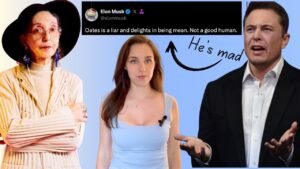
On November 8th, the 87-year-old famous American author, Joyce Carol Oates, replied to a screenshot of an Elon Musk tweet and mused about him as a person and his social media presence, writing the following:
“So curious that such a wealthy man never posts anything that indicates that he enjoys or is even aware of what virtually everyone appreciates— scenes from nature, pet dog or cat, praise for a movie, music, a book (but doubt that he reads); pride in a friend’s or relative’s accomplishment; condolences for someone who has died; pleasure in sports, acclaim for a favorite team; references to history. In fact he seems totally uneducated , uncultured. The poorest persons on Twitter may have access to more beauty & meaning in life than the ‘most wealthy person in the world.’”
Roasts from writers are always just gonna scratch that itch because good writers are able to perform a brutal takedown with such eloquence and thoughtful prose. And this tweet, even though it wasn’t tweeted directly at Elon, got back to him and seems to have really upset him. And this is a man who gets hated on on his own website… so much and with all manner of insults. But this was the one, saying he appears uneducated and uncultured, that really set him off.

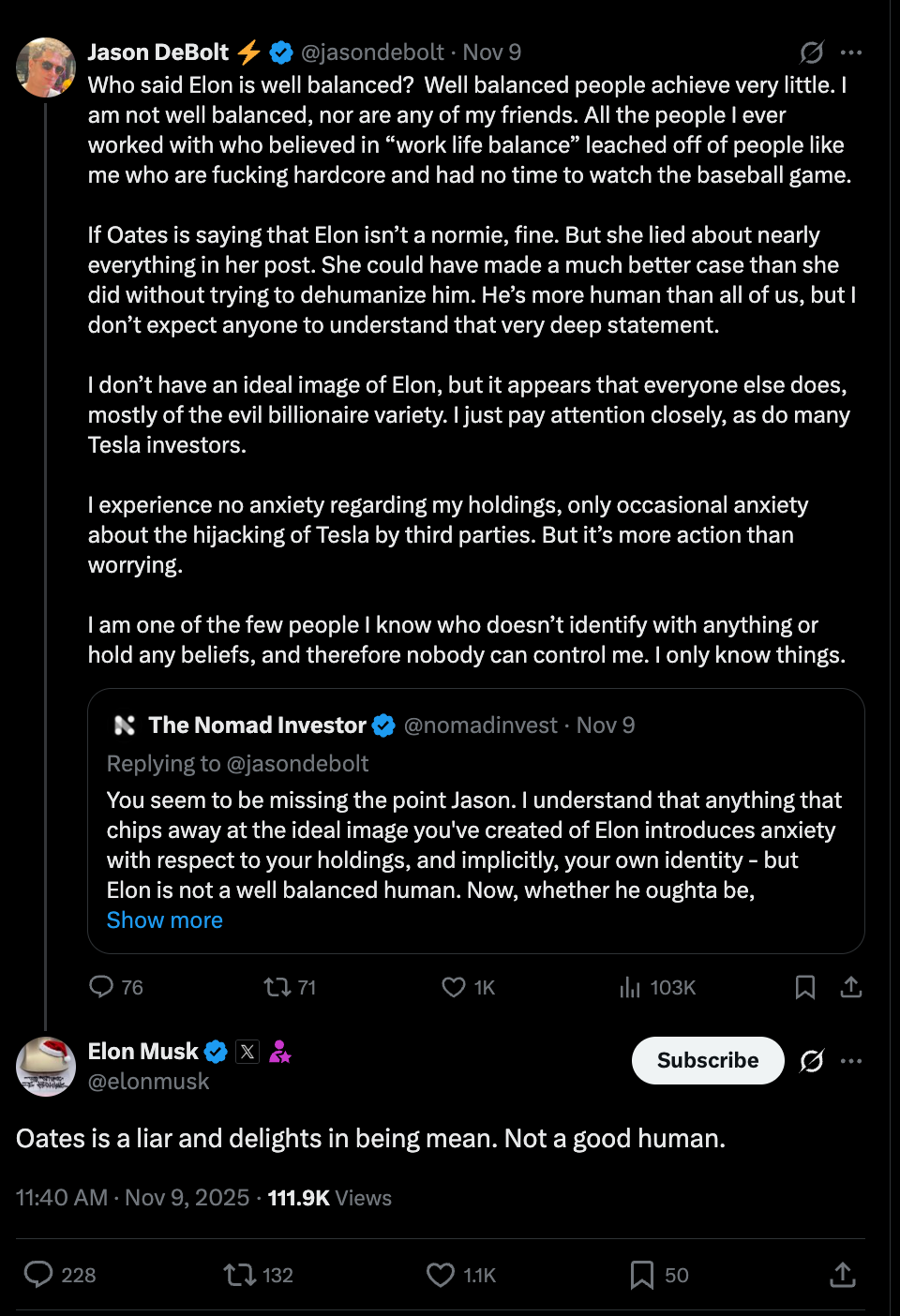
Of course, Jason DeBolt, whom I have never heard of in my life, is fucking hardcore and can’t watch baseball games because he would miss very valuable minutes and hours in his fast-paced, world-saving career of being a Twitter influencer.
Elon defended himself by saying that he does read; in fact, he claims that reading is important to him:

And in a hilarious turn of events, to prove Joyce Carol Oates wrong, he immediately responded thrice to a Twitter account that posts film clips to chime in and say things like “great movie.”


Using the word “great” three times in a row with no other adjectives does not bode well for his argument in favor of his own literary abilities, but let’s continue.
Then, in a similar vein, he also suggested a book. More specifically, an epic poem. Musk responded to a tweet saying:

Then he responds with a photo of The Odyssey, which is, as the title might suggest, not the Iliad.
So Joyce Carol Oates continues to reply. She retweets someone who said:

Someone else tweeted about Elon’s daughter, Vivian Wilson, saying:

Vivian Wilson is a good writer, I would add. Everything that I’ve seen her write publicly has been very high quality, which tracks because her mother is actually a novelist.
Then Oates gives Elon some credit for allowing people like her to criticize him so openly on his platform, writing:

But then, some people responded to her, claiming that that is not always the case, and he does, in fact, censure criticism of himself. Joyce Carol Oates retweeted one person who said:

Someone else then compared Elon Musk to Howard Hughes, writing:

Oates replied:

His daughter Vivian has written about how much of his more erratic behavior can be chalked up to his ketamine addiction. She once posted on Threads about her father, “[I]n a ketamine-fueled haze, he’s desperate for attention and validation from an army of degenerate red-pilled incels and pick-mes who are quick to give it to him.”
Oates then continues to reflect on wealth, writing:

And, in response to this tweet, Oates delivers the kill shot:

The Italian intellectual and politician, Antonio Gramsci, coined the term “cultural hegemony” to describe the process by which a ruling class of elites uses cultural trends of ideological opinions to control the working class. The 1% doesn’t need to dominate people with guns and tanks; they can just convince everyone through media and propaganda, things like: consumption is what will make you happy, or war is exciting and heroic.
One of the most commonly cited examples of cultural hegemony that permeates U.S. American culture is that your life should be spent being productive, and if you’re poor, it’s not because our systems require a class of underpaid or unemployed people in order to function; it’s because you didn’t work hard enough. It’s what Tim Kreider called The Busy Trap– the lie that what’s gonna make you feel fulfilled and happy isn’t music or nature or nutritious food or rest or time spent with people who love and support you– it’s 40 hours a week with big screen and 80 hours a week with little screen.
There have been few people who have so famously and publicly promoted the hustle culture as Elon Musk. Books about Elon Musk describe scenes of him sleeping on his factory floors because he saw it as his responsibility to lead by example. He has tweeted, “Nobody ever changed the world on 40 hours a week,” and in a response clarified that to change the world you must sustain 80-hour work weeks consistently, with peaks of 100-hour work weeks.
He expects this time commitment from his employees, with one of his biographers, Ashlee Vance, interviewing a SpaceX engineer who worked sixteen-hour days every day for years. Also, when Elon bought Twitter, he famously sent out a company-wide memo telling people to commit to an “extremely hardcore” work environment with “long hours at high intensity” or to immediately leave the company without severance.
His behavior could be an example of cultural hegemony; maybe he is promoting the hustle because it benefits him and the ruling class to have SpaceX engineers who work sixteen-hour days every day.
And that lifestyle is not coherent with the things that Joyce Carol Oates tweeted about: time to read for pleasure or time to walk and appreciate nature.
But no matter how much you hustle and how much money you make, you can’t buy taste. You can’t purchase a cultured and refined personality. I understand why it benefits Elon Musk and the 1% to promote hustle culture and thus engage in cultural hegemony, but then he can’t complain when people point out that he doesn’t come across as a very literate, cultured person. He claims to care about literature, but he’s never put his money where his mouth is– he is not a public patron of literature or the arts at all. But he doesn’t seem to like it when people point that out.
He wants to be perceived as someone who reads without doing the work of actually becoming erudite when it comes to literary classics. To be fair, Elon Musk’s biographers agree that he did read. As a child, he voraciously read science fiction and fantasy, and it seems to have shaped his life view, leading him to see himself as, as he got older, a hero– somebody who was tasked with saving humanity. He reportedly continued to read into adulthood, but he read not necessarily for pleasure, but more for utility; such as by reading engineering textbooks in order to find the answer to a specific problem.
But Elon Musk’s public image has changed significantly in recent years. Someone who was once seen as a quirky but ultimately well-meaning engineer and inventor has instead become regarded by a lot of people as almost a supervillain. So I don’t know if he still reads. He doesn’t embody the traits of a hyper-literate person; traits such as a capacity for nuanced or abstract thought when discussing social trends, metacognition and a sensitivity to propaganda or falsehoods, a resistance to over-simplification, or deep emotional understanding and empathy.
So I would say that Joyce Carol Oates is correct in saying that, looking at his social media, he doesn’t come across as a very literate or articulate person. He doesn’t seem like someone with an understanding of culture or even humanity as a whole. His social media is dominated by AI-generated hot girls and advertisements for his AI, Grok. When Grok started disagreeing with and questioning his far-right politics, instead of questioning his own takes or taking a cooler, intellectual, distanced perspective, he instead declared that Grok had also been infected by the woke mind virus, and he would be tweaking Grok until it reinforced his preexisting opinions. When he tweets about politics, culture, or social trends, his sources are not peer-reviewed studies or publicly respected intellectuals; they are anonymous propaganda accounts with fake profile pictures or members of his own army of sycophants. When I tried to find sources for his racist, sexist, or anti-LGBTQ takes, I was often led back to Grok or an anonymous far-right account or a pro-Elon-Musk account. He comes across as someone who maybe wants to understand humanity and social structures, but who can’t quite get there. Which is perhaps why it got so under his skin that Joyce Carol Oates called him uneducated and uncultured.
Joyce Carol Oates represents a cultural group that perhaps Elon Musk feels rejected by: what Antonio Gramsci would call the intelligentsia. These are the scholars, the academics, the teachers, the scientists, and the philosophers, who are native to the working class and who take the time to study, learn, and disseminate what they learn to those around them.
Joyce Carol Oates embodies a series of traits that Elon Musk lacks.
She grew up on a farm. She was the first in her family to graduate high school. She became a self-made success through scholarships and writing talent. Elon Musk claims to be self-made, and seems to want to be perceived as self-made, but he was objectively born into wealth.
As a writer, Joyce Carol Oates’ life mission, a mission she has completed quite successfully, I might add, is to understand and articulate the human experience. Elon Musk seems to constantly grasp at this artistic ability without ever fully expressing it. You can see the difference between his vocabulary and Oates’ vocabulary in even just this Twitter argument. Perhaps the reason why Elon was so hurt by these comments from Oates is because she has spoken from the position of someone who understands the human experience in a way he can’t. Elon has dated and married, almost exclusively, artists. His first wife was a novelist; his second wife was an actress. He had famous relationships with the musician Grimes and with the actress Amber Heard. It’s like there’s this part of him that is trying to reach artistry and social understanding– trying to embody the talent or likeability or coolness that many artists achieve, but he can’t quite get there.
Oates was a tenured professor at Princeton from the 1970s until 2014. Elon Musk was once a respected intellectual, but with his foray into politics, he has lost the admiration of many educated academics. He publicly claimed to have bought the 2024 election for Donald Trump and the Conservatives, and he has aligned himself with a party and an administration that show an active hostility toward the scientific method and higher education.
Elon Musk is thrice divorced and has never had a successful, long-term relationship with a woman, despite repeatedly trying to do so. Joyce Carol Oates is a famously prolific writer, but the one time she stopped writing was when her first husband died, and she realized that her love for her husband was so paramount in her life that suddenly nothing else mattered to her anymore, and she was driven to nearly suicidal grief. You can say a lot of things about Joyce Carol Oates, but you can’t say that she doesn’t know what it is to love.
Joyce Carol Oates has spent her life in parties that Elon Musk would not be invited to, because the intelligentsia doesn’t take kindly to fascists, and, to be fair, the feeling is mutual. Antonio Gramsci himself was jailed and murdered by Mussolini and his fascist regime.
I think there’s a misconception that pointing out cultural hegemony or being anti-hustle culture means that you are pro-stagnancy, as if we should all just bedrot and think about how much better than Elon Musk we are. But according to Gramsci, the way to fight against cultural hegemony is actually for normal working-class people to become educated and develop their own culture, beyond just what the ruling class wants you to believe. So it’s not inactivity, but rather hard work toward things that you really care about, not the things you’ve been told to care about. Because we all know Elon Musk’s name, but no one knows the name of the anonymous SpaceX engineer who worked 16-hour days every day for years.
Now, I have my own critiques of Joyce Carol Oates, but I think she really touched on something here. Many of us at this present moment are uneasy, to say the least, about the fact that the oligarchs who are making decisions about the future of humanity seem to have a misunderstanding of, or even a hostility toward, the very things that make us human. I loved that she said that even the “poorest people” have more access to beauty and meaning than the so-called wealthiest person in the world. It’s telling that a thoughtful, wise, and sensitive artist who has had an entire lifetime considering, teaching, and writing about the human condition doesn’t consider “wealth” to be simply financial acquisition. Most people who, like Joyce Carol Oates, have lived for almost a century will tell you that wealth is time, it’s health, it’s a calm mind that you’ve decorated over the years with poetry and art, it’s people and pets who get excited when you come home. Elon Musk recently tweeted a troubling video; he shared that he instructed Grok to create a beautiful young woman who would look at him and say, “I will always love you.” And I see that video as indicative of how he sees people and connection. It’s as if he were always attempting to be loved, but because he refuses to let go of his own self-affirming life views, he is forced to settle for a cheap copy of intimacy: a fake two-dimensional woman who will never challenge him.